Home Blog Page 7

I Ching Readings for Yourself and For Others

9
I Ching Readings

I Ching ReadingsWhen we do I Ching readings for other people, it’s because we want to help. We know what I Ching can offer, and we want to share that. But when you read for someone else, you don’t naturally recognize how the answer is speaking for them. It may not even happen at all. You may be uncertain if you actually recognize the querent in the answer, or if it’s your own baggage and preconceptions. Sometimes you’ll recognize the answers as things you yourself needed to hear.

Listening to the querent you’re reading for, and taking enough time to make sure their questions are good ones, can help a lot.

In your personal relationship with I Ching, you may have become relaxed. You may be able to ask for a “yes” or “no” answer with the understanding that I Ching will address the questions behind your stated question. You probably recognize when I Ching is addressing deep, underlying concerns that you should be asking about instead.

But none of this is likely to work when reading I Ching for somebody else. To hear I Ching’s answers, beginners must hear the question that’s being asked. Hearing the conversation is also crucial for you, the reader: it gives you a solid foundation to separate your preconceptions from I Ching’s answer.

When you analyze a reading, you likely see complex layers of meaning: there’s hexagram text, hexagram shapes, trigrams, nuclear hexagrams, associated history and myths, as well as vivid, emotional experiences of your own.

It’s tempting to hop on the “easy I Ching for modern users” bandwagon, saying “making a change” instead of “crossing the great river,” or “be very careful” instead of “treading the tail of the tiger.” But don’t hop on. Simplifications are forgettable. Tigers’ tails are not.

You need to escort your querent into the vivid imagery. Help them make themselves comfortable in a realm where nothing will travel quicker than a horse, where tigers are protective spirits but occasionally eat people, and where wading across rivers is treacherous. You might have to choose just one image from among all that you can discern in trigrams and text. But giving readings will always involve imagery.

One more tip: have clarity in your own mind regarding readings’ basic structure. Know what’s represented by the primary and the relating hexagram. Understand the working relationship among the diverse moving lines. This is essential to the interpretive skills you use to draw out the meaning of readings.

Don’t Burn Out

About six years ago, I burned out. I didn’t know if I could do I Ching readings ever again. I’d been available to do readings for more than 10 years, except for a random week off here or there for family emergencies and responsibilities. I ran out of the essentials and needed to hide away. I spent long, long hours sitting in the shade of a maple tree with no plans at all.

Divination differs considerably from coaching or counseling because the actual source of answers is not the diviner. It’s the I Ching. But serving as the conduit for I Ching’s help definitely is work. So, don’t do what I did. Don’t make yourself unconditionally, absolutely available to carry anything and everything for anybody or everybody indefinitely at any time!

Like most people, you probably would have enough common sense to not put yourself in a situation like that in the first place. But even if you’re only available for occasional readings for friends or family, you’ll still bear the weight and responsibility of their expectations.

I don’t have any one-size-fits-all solutions to this. I think the best I can do is share some of the helpful answers I’ve found to my own personal questions. Your answers will probably be different, but you should probably seek them before you do a lot of readings.

I learned I need to care for myself by spending time outdoors. I need to take time off from doing readings full-time. I need trees and sunshine in the sky. Occasionally, if I worry about a specific querent, I seek out somebody I trust and confidentially share about my worries. I understand my responsibility as a diviner in that I’m responsible to give the reading as thoroughly and as expertly as I possibly can.

If my querent doesn’t understand it, I have to try different ways of communicating, and continue until they get it or I run out of ideas. If the querent resists what I Ching says at the time, I make the information memorable, so they can benefit from it later. If they don’t answer my calls, I write out my notes and email them. If somebody requests a refund before the interpretation, I’ll send it, but I’ll also send the interpretation. Doing readings for others is a sacred undertaking. I do everything I can to deliver it to them. If the zombie apocalypse begins while I’m working on somebody’s reading, I guess I’ll have to type it out before I get on my bike and skedaddle!

But I don’t bear responsibility for the outcome. I’m not responsible for how the querent interprets the reading. And I’m absolutely not responsible for what they choose to do. I trust I Ching to do its thing, and I trust the querent to choose their own path. At least, that’s what I keep striving to do!
Technology, Coins, Yarrow and the I Ching

13
Technology, Coins, Yarrow and the I Ching

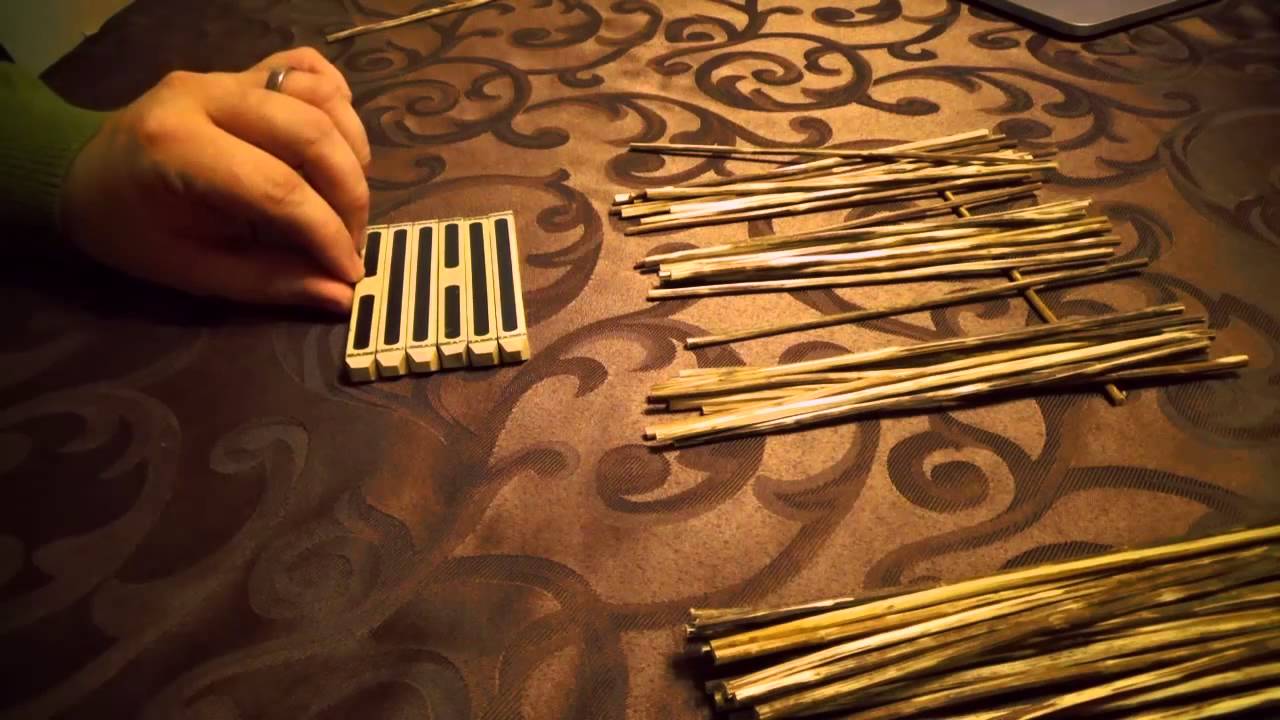
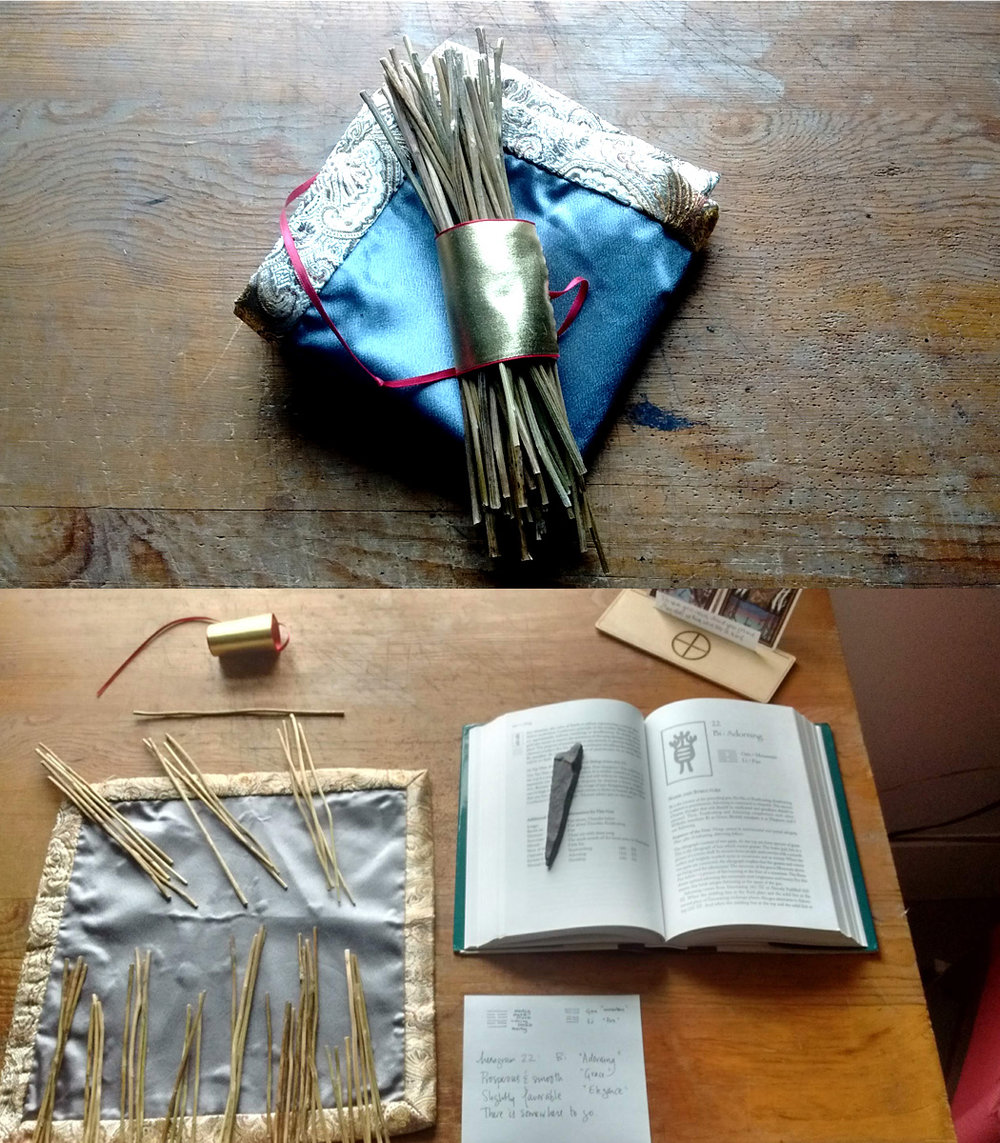
Technology, Coins, Yarrow and the I ChingI Ching is Chinese for “Book of Changes.” The I Ching all about change, which is always happening—it’s the only constant in life. An ancient method for casting an I Ching reading was an involved process of sorting fifty yarrow plant stem stalks. The modern method is tosses of three identical coins with distinct heads and tails sides. A series of six tosses produces the six lines of a hexagram. Like buildings, I Ching hexagrams are assembled from the ground up. The bottom line is the first line in text interpretations.

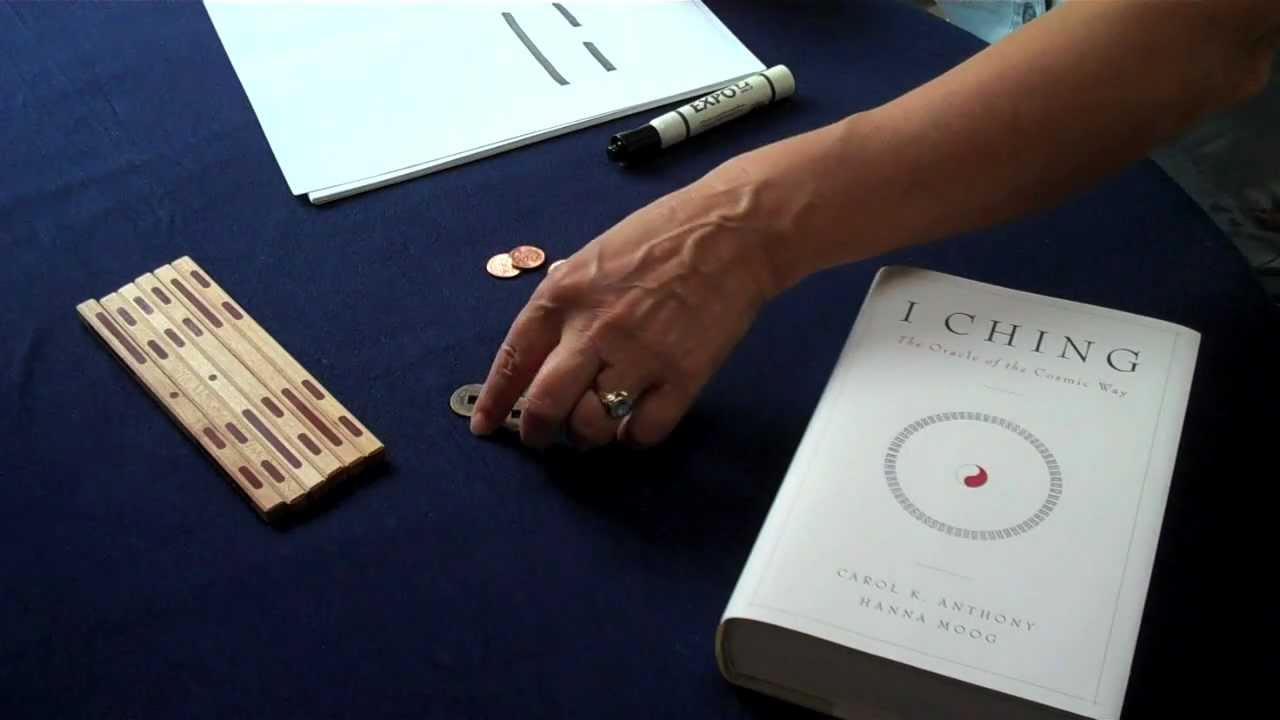
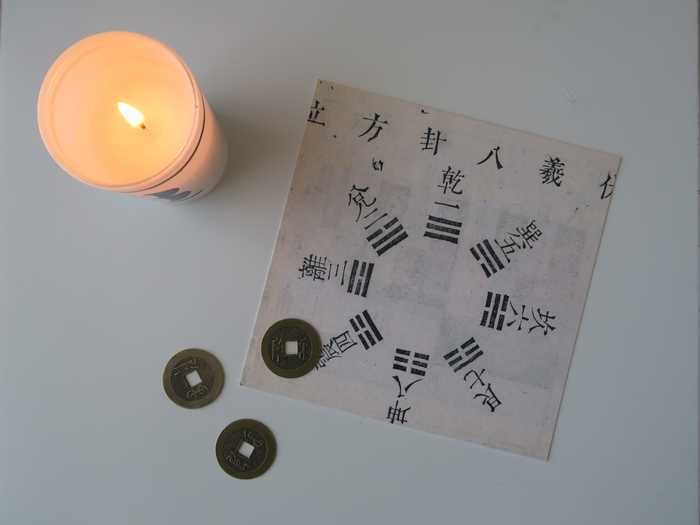
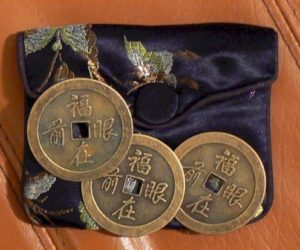
An easier, more hands-on method to cast I Ching uses three coins. Bronze Chinese coins with a square hole in the middle have no obvious heads or tails sides, so before you begin, choose which side is which and stick to that designation every time you cast.

The easiest and most modern way to cast the I Ching is to use an online simulation or an app. These methods preserve the mathematical odds inherent in the ancient yarrow stalk method to obtain each line, as well as the energetic connections behind the tosses. Your resulting lines depend on how you shake and the timing of your clicks on the icons on the screen.

Using Coins for I Ching

Technology, Coins, Yarrow and the I ChingWhen you use coins to cast your I Ching reading, here are some important things to keep in mind.

  • Focus on your question, subject, or dilemma when you cast.
  • While staying focused, loosely hold the coins in your hands, briefly shake them, and toss them. To determine the line you’ll record, assign a numerical value to each head and tail you tossed, then add up the total. Each head is worth 3, and each tail is worth 2. So if you tossed one head and two tails, your starting line will be 7, because 3 + 2 + 2 = 7.
  • Gather up the coins and toss them five more times. Record the numerical value and the corresponding line for each toss. This will build your complete six-line hexagram.

This hexagram is considered to be your “present hexagram.” To generate a “future hexagram,” change each line to its opposite value. In other words, change any broken Yin lines originally marked with an ‘“x” into solid Yang “o” lines, and change any solid Yang lines originally marked with an “o” into broken “x” Yin lines.

As mentioned earlier, I Ching is all about change. So if your hexagram contains no changing lines (that is, a 6 or a 9 value), this means that the situation surrounding your topic of concern is relatively stable or not in a state great flux at this time.

After you identify your present and future hexagrams, use an online hexagram identification chart for an interpretation. When reading your interpretation, consider just the changing lines you tossed. You will also be able to view artwork that corresponds to your hexagram. I Ching apps can fill in more details for you, identifying subtleties of your tosses and take much of the busywork out of a consultation.

More I Ching Resources

Paul O’Brien’s The Visionary I Ching is an expert translation including original paintings for each of the 64 hexagrams. The text updates the historic oracle’s language, yet carefully preserves the core of its consequential decision-making knowledge. The I Ching text is also available as an e-book.

Additional I Ching books available today offer a wide variety of interpretations. Some adaptations modernize the text, remove gender bias, and update the archaic language. Other translations include interpretations and elaborations on the explanations, offering rough paraphrases of the original text.

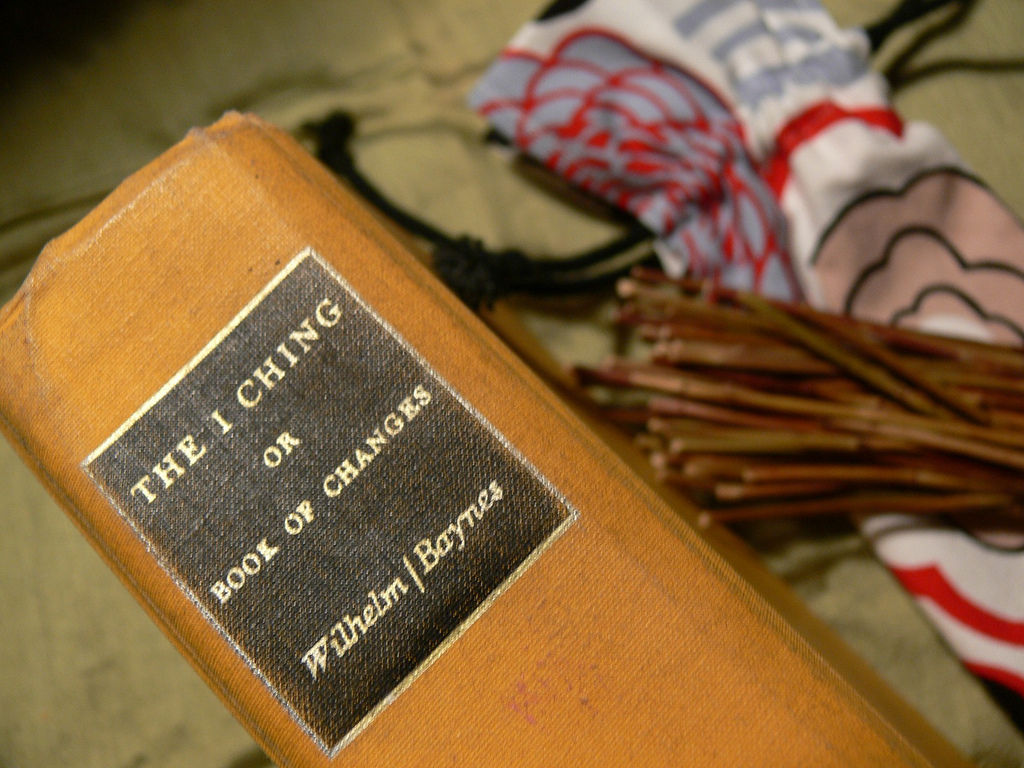
A significant range of quality can be found amongst the translations. The most famous, Wilhelm’s version of The I Ching or Book of Changes translated by Wilhelm and Baynes with a forword by Carl Jung, is tainted by 19th-century politics and trends Germanic, as it was first translated from Chinese into German, then translated into English from the German. It faithfully preserves the sexism and militarism of patriarchal Chinese society prior to the time of Confucius, which some readers find quite confusing. Another version faithful to the original Chinese but easier to understand is The Complete I Ching: The Definitive Translation by Shanghai’s Alfred Huang, who is a Taoist Master and a contemporary I Ching scholar.

The History of the I Ching

11
The History of the I Ching

The History of the I ChingThe I Ching is a book of wisdom that is used as a system to predict the future. The readings it gives are simple, yet intuitive, profound, and elegant. It is often used to gain insight and advice regarding human nature. It can also be simply read as an account of human affairs. The book is just as influential today as it’s been for hundreds of years.

It’s likely that before the I Ching, sets of oracle bones were cast to try to know the future. Such bones have been unearthed by archaeologists.

Nobody knows for certain who wrote much of the I Ching. The main text itself has existed almost since the dawn of recorded history. The first evidence of its existence date to the Zhou dynasty, around 3,000 years ago.

Even then, philosophers recognized the fundamental principle that Tai Chi, The Great Ultimate, existed in the beginning, and the yin and the yang sprang from it. Yin and yang are the forces that are responsible for the changes in the world. The yin, a nurturing and yielding feminine force, is represented by a broken line. The yang, an aggressive and active masculine force, is represented by a solid line. Although the two forces are opposites, they complement each other perfectly.

We can use our knowledge of yang and yin to make conclusions and predictions of the future. Everything in the world is subject to change. Day gives way to night, and summer yields to winter. But there are cycles and patterns within the framework of change. These patterns often precisely repeat themselves. Some patterns exhibit the extremes of both yin and yang within their cycles. This allows us to easily make simple projections about the future.

Events like the exact moment of sunset or the date and time of high tides can easily be predicted. This was not always so. The first mathematicians to learn through science to predict phenomena such as solar eclipses were even suspected as wizards.

The History of the I Ching Predictions like these dealt mainly with the inanimate world. But living things, including ourselves, are subject to the same processes. These processes never change and always govern how we act, so they’re considered universal laws. Once these ideas are accepted, it’s easy to see how a divination system was constructed.

The I Ching System

The I Ching system first generally organized human experience categories. Then it devised a method of discerning which events would most likely happen at a given time for a specific person. This is how the I Ching authors constructed the system.

The I Ching uses broken lines to represent yin, and solid lines to represent yang. It can then express the relationships between the two forces. But using just two symbols limits the number of relationships that can be represented to only four.

The genius of I Ching is that it organized yin and yang into trigrams (sets of three separate lines), yielding eight possibilities. Each individual trigram is then paired with another, forming a larger group of six lines. This group of six lines is called a hexagram. Hexagrams allow yin and yang to yield eight different combinations. Ancient sages used these combinations to represent the eight forces of nature.

The mythic ruler Fu-Hsi is credited with developing the eight trigram system. Fu-Hsi was a divine being with the body of a snake. He also gave humanity multiple incomparable gifts, including skills like animal husbandry and using nets for fishing. He created musical instruments and developed a system of communication that used knotted cords.

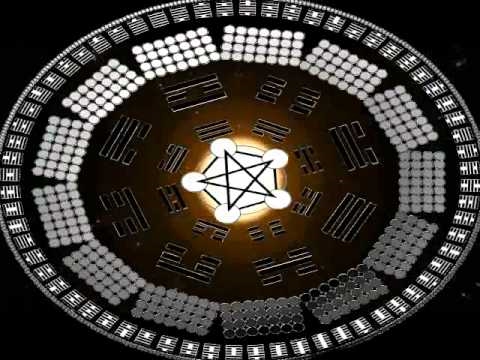
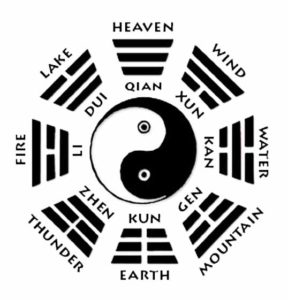
Fu-Hsi developed the trigrams to organize all heavenly and earthly phenomena in a comprehensive, but simple, framework. When the trigrams are arranged in a circle around the central Tai Chi symbol, they become the philosophical precursor to I Ching. The symbols were devised as ancient mythical abstractions and therefore are likely the basis for practicing divination.

Its simplicity is the most appealing feature of I Ching. It allows all phenomena to be organized into one of the eight main trigrams. Each then becomes an icon. For example, the symbol identified as Heaven encompasses concepts like father, day, wealth, and ruler.

The world has changed significantly over thousands of years. It seems that the world then was far less complicated and far more straightforward than it is now. As the world transformed, Fu-Hsi’s system did, too, until it finally evolved into the complex analytical system we now know as I Ching.

Practical Tips for Accessing Your Intuition

10
Practical Tips for Accessing Your Intuition

Practical Tips for Accessing Your IntuitionYour intuition, or what you might refer to as your gut instinct, is a vital key healing the mind, body, and soul, making important decisions, When you’re able to access and successfully listen to your intuition, you have a powerful ally in yourself when it comes to fulfilling your calling, being part of open-hearted relationships, and making positive, conscious choices.

Sometimes, however, it can be difficult to access your intuition. For some, it may come easy. They may be very in tune with their intuition through clairvoyant visions, direct knowing, prescient dreams, and messages from animal totems and spirits guides. But for those of us who seem to have trouble accessing our intuition, we can feel frustrated and out of touch, making us out of tune with that gut instinct. Not to worry thought, there are plenty of ways you can help access your intuition better and be more in tune with your gut instinct so that you’ll be well on your way to making informed, positive life choices with the help of your inner-wisdom.

Use Your Body as a Compass

In order to access your intuition and be more in tune with it, first you have to be more in tune with your body. Your body is always communicating with you by reflecting your energetic vibrations. You must be able to assess when your body is out of tune and out of alignment with your truth. Once it’s been corrected, you’ll also be more in tune with your intuition.

Meditate

When your mind is busy and full of chatter, you’re not going to be able to access your intuition. Intuition tends to communicate quietly, so you should in turn have our mind in a quiet state when you’re seeking out the guidance of your intuition. Meditation is the best way to quiet the mind and let your intuition come through to you.

Meditate

Get out Into Nature and Convene with it

Nature is a healing thing. It’s good for the mind, body, and soul…especially if we’ve been cooped up at the office all day. And convening with nature is also a great way for you help better access your intuition. Take in your surroundings while you’re outside and allow yourself to hear the messages nature is giving from all around you. You may find that the trees and breeze rustling the leaves have plenty to say. So, be receptive to whatever nature is telling you, and use that to be better in tune with your instincts.

Analyze Your Dreams

Dreams are a way for our subconscious to communicate with us while we’re sleeping. And your subconscious will definitely know a thing or two about your intuition. Keep a dream journal beside your bed and record your dreams each night. From there, you can begin to analyze your dreams for symbols and meanings. This will help you hone your intuition and be better in tune with what is best for you.

These are just a few tips to help you get started on gaining better access to your intuition. You can also seek out a psychic who specializes in intuitive readings. He or she will be able to help you strengthen and make the best use out of your gut instincts, giving you a positive advantage when making difficult or life-changing choices.

I Ching: the ancient Chinese divination text book

13
iching book

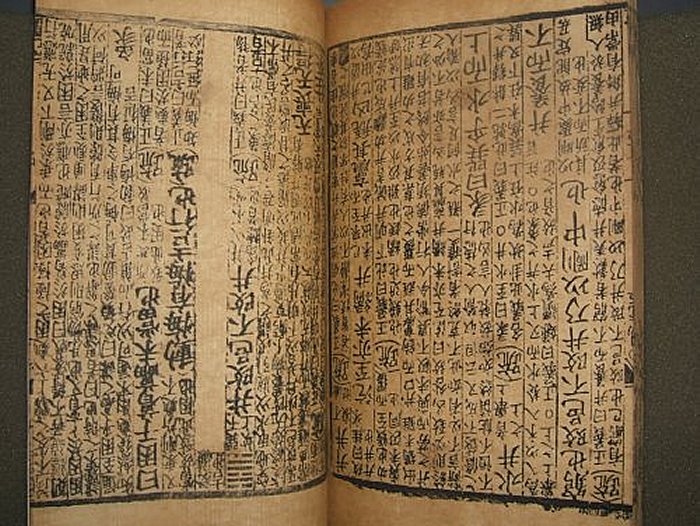
iching bookI Ching or the book of changes is an ancient divination text book. It’ the world’s oldest wisdom book, used to predict the future’s events and one of the greatest Chinese books ever written.

The I Ching has served for thousands of years as a guide to an ethical life, a manual for rulers, and a prediction of one’s future. In incident China and East Asia, I Ching has been the most consulted of all books, as it was believed that it can explain everything. It has been known for over three hundred years in the West and surely it is the most popularly recognized Chinese book. With its interpretations, there has never been a book like it anywhere.

I Ching is a philosophical matrix, a divination methodology, and it contains a lot of historical events which are hidden among the book’s hexagrams and lines. This book has influenced some of China’s greatest thinkers and has played extremely important role in Taoism and Confucianism. It is one of the “five ancient classics” and probably the oldest written form of known divination in the world.

This book has been offering people help and wise, and divine guidance for generations. The book is divided into 64 chapters or hexagram, each hexagram is a pile of six lines, either broken or solid.

Each inquiry will form a hexagram reading and a hexagram has six changing lines. Each hexagram is made up of two trigrams and there are eight possible trigrams. Each trigram is made up of three lines. Each line is either broken or solid, corresponding to the complementary Yin which is negative and Yang which is positive. Three Chinese coins are used for the throws. Each throw creates one line of the hexagram. Thus, six throws decide a hexagram. One side of the coin (head) represents a two and the other side (tail) represents a three. These numbers are added to determine the result of the throw as follows:

3 heads = 6 Broken = ——- ——
3 tails = 9 Continuous = —————-
2 heads + 1 tail = 7 Continuous = —————-
2 tails + 1 head = 8 Broken = ——- ——
2 heads + 1 tail = 7 Continuous = —————-


I Ching

How to form a hexagram?

  • 6 (3 tails) is a changing yin and is drawn as a broken line with an X in the middle (broking changing line becomes solid)
  • 9 (3 heads) is a changing yang and is drawn as a solid line with a circle in the middle (solid changing line becomes broken)
  • 7 (2 tails, 1 head) is an unchanging yang, and is drawn as a solid line.
  • 8 (2 heads, 1 tail) is an unchanging yin and is drawn as a broken line.

How to interpret hexagrams?

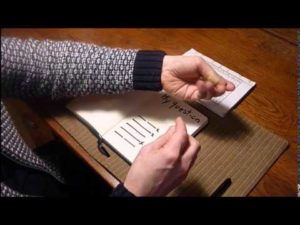
On a piece of paper, ask your open-ending question and start toss your 3 coins 6 times and write the corresponding line whether broken or solid and once your first hexagram is formed, find the matching hexagram pattern from I Ching book and read the description of this hexagram pattern

If you don’t have a copy of I Ching book, you can go online and find a list of hexagram interpretations and search your hexagram pattern to see what the answer to your question is.

You can also use a hexagram calculator by inputting the result of each coins toss and once you finish up entering results for 6 lines, the calculator will locate the proper hexagram for you and give you the meaning.

Utilizing Wisdom from The I-Ching

9

We could all probably use some wise, enduring life lessons that have been around and practiced since 2,850 BC, right? Especially when it comes to needing help making major life decisions and advice on how to apply a workable, balanced approach to any situation. And that’s exactly what can happen if we apply the teachings of The I-Ching or “Book of Changes.”

So, what exactly is The I-Ching? Well, it originated in ancient China and was founded on the philosophy of Taoism. The I-Ching promotes unity, harmony, balance, and wholeness through a spiritual living and awareness. Its teachings have survived centuries and are used in so many spiritual and psychic practices and tarot card readings today.

Understanding Taoism

Understanding The I-Ching means also understanding the practice of Taoism. What is meant by the term Taoism? Taoism suggests that instead of aspiring for perfection, one should instead aspire to travel towards a state of wholeness. It teaches way of balance and harmonizing towards the ultimate reality or spirituality. It’s not just a set of ancient ideas, but also a way of using those ideas in the present…for a more harmonious state of being.

Can The I-Ching Be Used for Fortune-Telling?

The writings and philosophies in the I-Ching were written mostly to focus on the here and now. However, the texts can predict probably outcomes from how we take the words and wisdom and use them in our everyday lives to enhance our future. Obviously, it can’t predict the future, but it’s writings can be used to help you find new solutions and ideas that can help shape your future.

How Can The I-Ching be Used for a Reading?

The whole process in which we use The I-Ching for a reading can get a bit complex. To explain it in a bit simpler way, a random method of divination is used, allowing relevant text to be chosen by your subconscious. It’s a technique that allows you to bypass your ego, which usually is responsible for blocking your true insight. And this allows the text of The I-Ching to tap into your subconscious needs, wisdom, and desires.

In order to gain the most amount of clarity from a reading, it’s ideal to ask a specific question that is of deepest concern to you or about a current issue that has been bothering you. Because The I-Ching will reflect this back to you regardless of what it is you’re asking.

I-Ching readings are beneficial if you’re looking to align with your inner truth, act with purpose and faith, and boost your creative potential. And reading and studying the wisdom and philosophies within the text can help set you on a more truthful and self-aware path.

The I Ching and How to Consult It

12

Traditional methods indicate I Ching readings entail heavy labor – requiring the collection of fifty stem stalks of the yarrow plant. Modern methods are more straightforward, simply asking for a series of coin tosses using three coins that feature heads and tails imagery. Both methods ask for this to be repeated six times to represent each line of a hexagram.

If you decide to go with the coins technique and the coins you are using don’t have clear heads and tails imagery, decide for yourself which side will represent heads and which side will represent tails and ensure you stick with this decision throughout your use of them. You will need to assign each side a numerical value – heads is usually a 3, and tails is a 2.

When casting the I Ching, you will need to have a clear focus on your end goal.

Briefly shake the coins in your hands, holding them loosely. Once you have done this, release them, all the while continuing to focus on your end goal. Using the numeric value that you have assigned to each side of the coin, record the numbers you have landed on and total them up to determine a starting number.

Each number will represent a specific line formation. Please see what the lines should look like in the image below.

Coin combos Number Line
3 heads 9 o
2 heads, 1 tail 8 —    —
1 head, 2 tails 7 ———
3 tails 6 — x —

Repeat the process of tossing the coins a further five times. Continue to record the coin combinations, total number, and corresponding line each time.

The result will be that you’ve created a hexagram, which will be your present hexagram. You must create a future hexagram by changing all the lines marked with an ‘x’ or a ‘o’ to their opposition. Just like Yin and Yang, a broken line (‘x’) can be flipped into a solid line (its opposite)—and solid lines (‘o’) can be flipped into the Yin lines.

The I Ching translates to ‘Book of Changes’, and as you might expect, refers to the changes that are constantly happening all around us. When casting the I Ching, if you do not create any changing lines when creating your hexagram, this is an indication that conditions relating to the subject for which you are casting the I Ching are secure at present.
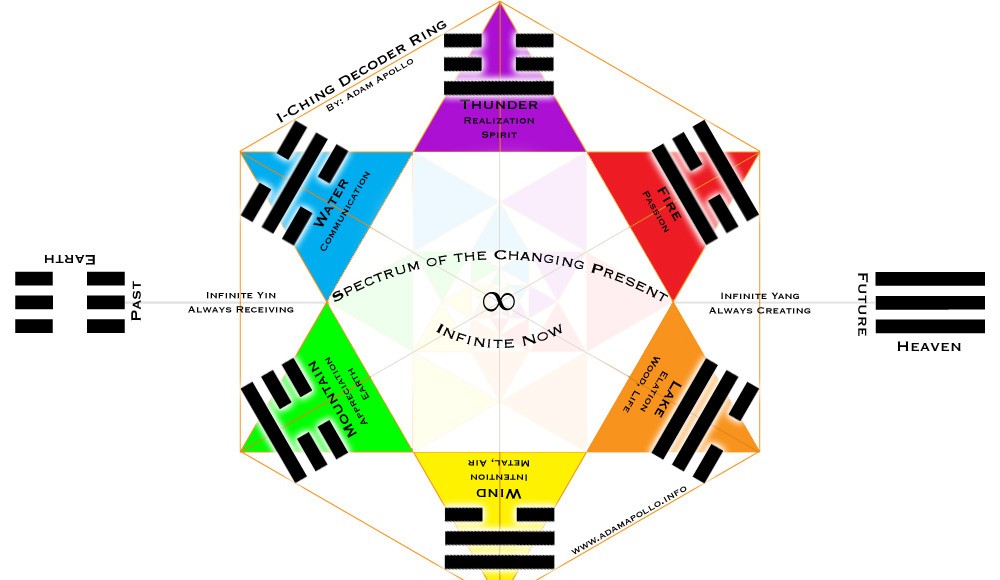

Next, you can locate your hexagram numbers and, as a result, receive your interpretation, using the hexagram table we have included above. This is done using only the changing lines. (As a bonus, you are able to view the hexagram artwork in the process.) The Visionary I Ching app does most of the leg work here.

For more references and books on the subject, it’s worth reading Paul O’Brien’s evocatively illustrated and in-depth The Visionary I Ching. It’s a great update of the original text, and it is also now available as an eBook.

There are, of course, other options, ones that clean up the archaic language of the original as well as the gender bias. Some, however, only paraphrase the original text in a vague way. The most famous is the Baynes/Wilhelm version, but it’s very much of its time (the 19th century) and, because most Chinese texts around that time were first translated into German, is slightly Germanic in tone. It’s possible also too faithful to the original – this is admirable, of course, but also makes it highly inaccessible.

The benefits you can derive from an I Ching reading

8

The I Ching also known as Book of Changes. It is an ancient Chinese divination text. Book of Changes was written around 1000 BC. Although it is thousands of years old, I Ching is one of the most sophisticated divination systems ever devised. the Book of Changes has been used by Chinese political and military leaders, as a source of guidance and wisdom, and as a tool to assist in strategic decision-making.
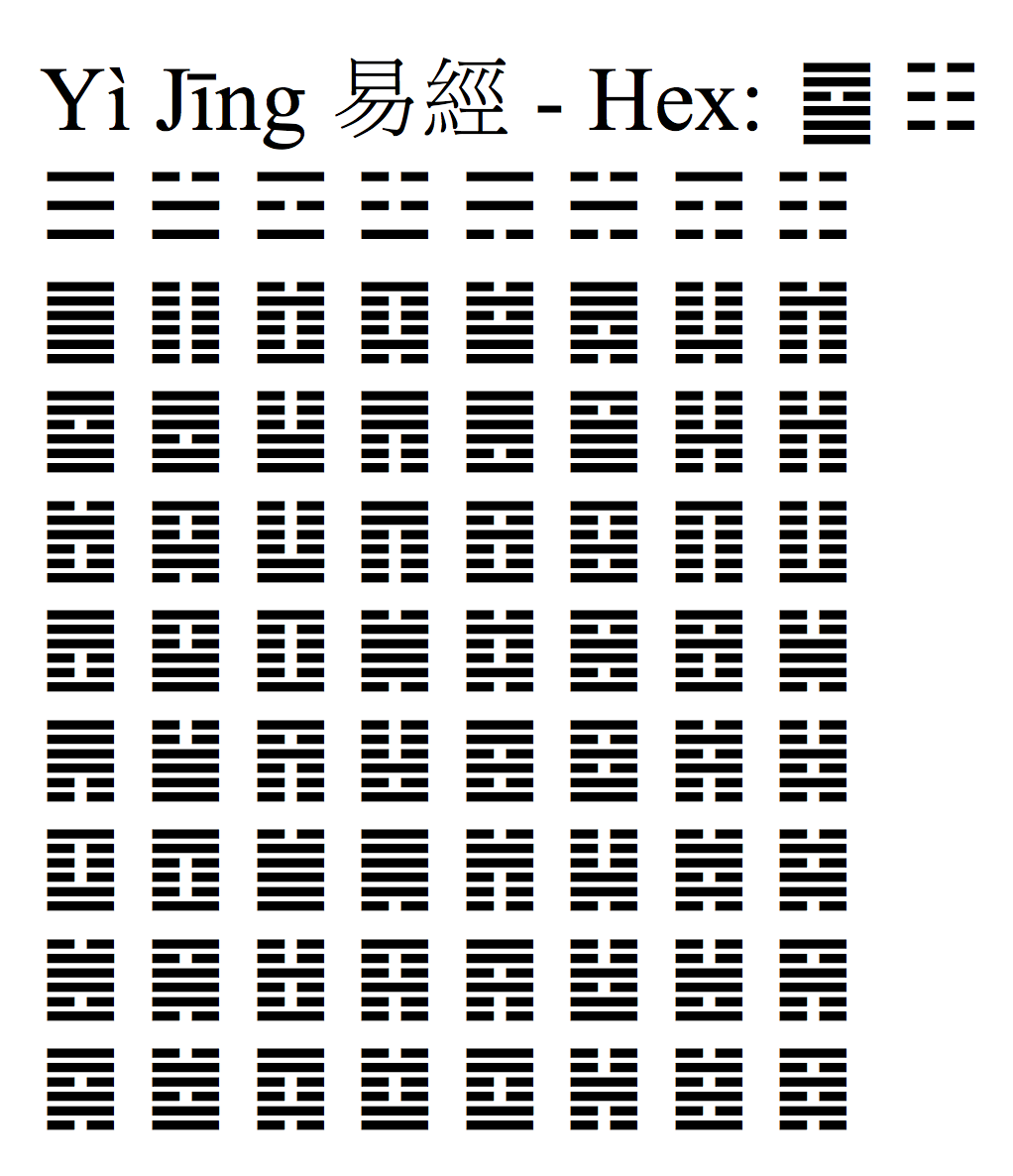
Talking about the benefits of I Ching consulting to make better decisions, here are some of the benefits of giving yourself an I Ching reading.

I Ching Benefits

The I Ching divination system was a human original change management tool. When it comes to a strategic decision-making tool, the I Ching guides us to enthuse our intuition, boost our creativity, improve our timing and make better decisions.

Make better decisions

Our level of success and happiness in all areas of life is measured by how good the decisions we make. No matter how much information you have, it’s normal to have doubts about whether you’re making the best decision or not.

Consulting the I Ching makes dilemmas easier to resolve. In addition, I Ching provide us with support to help make decisions easier to live with. Stressful situations transform into definite opportunities, and confusing relationships can take a turn toward greater clarity and understanding.
Mental relaxation

Studies have proven that focused relaxation is the best state of mind for intuition and creativity. The I Ching allows you to focus on personal importance issues with less stress aligning the conscious and subconscious mind so that they can coordinate with each other and connect with the spiritual dimension for extreme wisdom and effectiveness.

Accepting changes and taking tough choices

I Ching is not just a book of wisdom; it will also help you accepting changes and make tough choices easily. Through I Ching readings, it is possible to foresee events and adjust our actions and choices accordingly. Imaging how would your life change if you knew the events’ outcome in advance?

For example, if you are applying for the same job in two different companies. Both companies offer you same position with same salary and benefits. However, you still need to know which working environment will work best for you and which one is hard to bear. Of course, knowing the answer, will help you make a better decision.

I Ching seems extraordinary to me, in terms of its ability to multiply uncertainties, in its demonstrated efficacy whether by accident or by design. And if I still use this ancient divination tool, it is not because I want to escape from reason into the irrationality, nor is it because I believe the book contains a deep wisdom. Instead, it is the fact that the I Ching repeatedly prompts me to go beyond false certainties.

Have you ever read the I Ching? If so, what do you think about the book? If not, what are your thoughts about the book so far?

Advantage Of An I Ching Reading

10

     Not a lot of people are familiar with I Ching, also known as the “Book of Changes”. It is an ancient divination tool utilized by the Chinese for at least three or four thousand years, and an I Ching reading is just one of the many services I and other readers on the PsychicOz network offer.

I Ching began with reading turtle shell markings. That evolved into seers throwing yarrow sticks and interpreting how they landed. Today, the process has been simplified using three coins. The coins are thrown six times. Each toss creates a broken “line” and after the six lines are made, a “hexagram” is the result. The hexagram then references the interpretation—both contemporary and traditional. The interpretations have a way of being both practical, deeply esoteric, and spiritual at the same time. Often, the question we ask doesn’t receive a direct answer, but the answer that is relevant and necessary.

I Ching Readings are all About Change

The I Ching is all about change—the yin and yang, continuous flow, the masculine and feminine, and cycles within cycles. The I Ching defines these cycles by the use of 64 hexagrams. When a client asks for an I Ching reading, they can throw the coins or the psychic may do it. Then the reader finds the definition of the hexagram and the discussion can begin. The client may or may not wish to share the question with the psychic and that’s okay. All topics of inquiry can use this method of divination, such as relationship, work and career issues, and generally any personal situations that might be generating stress or confusion.

Addressing the Essence of an Issue

The advantage of this process is that there is no way to influence the interpretation because the coin tossing is seemingly random. This makes the reading totally objective, which can augment a somewhat subjective psychic reading. Personally, I have never found an I Ching reading to be irrelevant as they always address the essence of the issue at hand. The gift that the I Ching delivers to all who utilize its ancient wisdom is that it always appeals to our best qualities both personal and spiritual and it does so in a gentle, respectful manner.

Cutting Through the Inaccurate or the Contradictory

Sometimes, in an effort to find emotional safety or stability, people will gravitate to multiple psychics and this often results in conflicting readings and increased confusion. I have found that the I Ching is the perfect medium for cutting through the “veil” of information that is either inaccurate or contradictory.

The Return of a Partner

I once received a call from a woman who had been waiting for the return of a partner that was completely out of touch with her for over a year. All the psychics and there were many, did agree that he would be returning but their timetables had all come and gone with no positive result. I had never talked to this woman before and she seemed to be merely repeating a behavior that had not really worked for her in the past, so when I gave her a timetable she actually asked me why she should take me seriously when no other psychic had had the timing down. I couldn’t honestly answer that question to her satisfaction.

The Past Keeps You From Moving Forward

I then told her to get three coins. I asked her to toss them and give me the results—heads and tails. She repeated this five more times so I could get the hexagram. The primary message of the hexagram was this: “You wish to move on, but you are focusing on the past. You wish to cross the river but you do not want to get wet. So, you are stuck. The river represents Spirit. So take the risk and unstick yourself. Let the past go, let him go, and now embrace the present.” She got the message and it was only for her. We hung up.

She Got Her Wish

She called me back about two hours later and told me that within an hour of our talk, he actually contacted her and asked her how she was. Because of the I Ching reading she was able to say to him, “What do you want?” He was soon apologizing for his absence and the pain he was causing her. Her reading told her to let go, and the moment she did, she got her wish. It was never about him. It was all about her.

Using the I Ching over the years, I know to ask a question only once and abide by the results. I treat the method with respect and reverence. Confucius said that if he had another life to live he would devote it entirely to the I Ching.

Use I Ching For Wisdom

9

        Anyone can agree that life can be so complicated and unpredictable… It’s only natural that many of us seek answers to comprehend our current situation and how the future may unfold. While many of us are familiar with Tarot cards, pendulum readings or even crystal ball readings, there is an ancient Chinese oracle practice called the I Ching.

What Is I Ching?

The I Ching is a complex and fascinating oracle that features a collection of wisdom that translates as the “Book of Changes.” The I Ching collection features 64 situations that are represented by a six-line hexagram.

In order to figure out which hexagram relates to your situation, you throw coins to determine each line of the hexagram and whether or not it’s whole or broken. If a line is broken, it indicates “yin” or feminine energy that is moody, earthy and passive, while an unbroken line indicates “yang” or masculine energy that is fiery, bright and active.

How to Consult the I Ching

The I Ching tradition started by “throwing” fifty yarrow stalks to determine each of the six lines of the hexagram. In current times, it is more common to throw three coins a total of six times while concentrating on your question or concern.

The hexagram is built from the bottom line to the top using values calculated by how many coins were heads up or tails up. If a coin lands heads up, it’s given a value of two. If it lands tails up, it’s given a value of three and the value of each coin is added together. If the total sum is an odd number, the line is determined to be yang and if it’s even the line is determined to be yin.

There are also changing lines, which change from yin to yang or yang to yin. It is considered a changing line when all three coins are either heads up or tails up. It’s important to know how many changing lines there are in the hexagram as that gives you further insight into how to interpret the hexagram for your situation.

When to Consult the I Ching

The I Ching is poetic parables that leave much room for personal interpretation. It’s not too different from receiving a Tarot card reading, except it focuses less on the background of your situation and more on the options that you now face and potential outcomes.

There is much to consider and interpret when consulting with the I Ching as an oracle. Many experts suggest that you work with a trained professional to guide you through this powerful tool. Working with an advisor who specializes in the I Ching will give you a deeper understanding of your reading and how it applies to your situation. They will also be able to fully illuminate the nuances of the hexagram and how it applies to your life.

Whenever you have questions regarding your current situation or which path will lead you to your desired fate, it can be illuminating to turn to the I Ching to gain clarity and wisdom.