Home Blog

Daily Spiritual Protection Rituals: A Simple Practice With Boundaries

Man looking at a small stone in his palm while sitting on an entryway bench.

A daily spiritual protection ritual can be a quiet way to mark your intentions and remember the boundaries you want to keep. A prayer, a familiar image or a small meaningful object may help you begin the day with a sense of connection.

You can explore that practice without deciding that every uncomfortable feeling is an attack. A ritual need not become a test of whether you are protected enough. Let it support a life in which you can pause, make practical choices and ask for help.

Give protection a clear purpose

Choose a specific intention such as “I will listen without promising more than I can give” or “I will take a break before answering an upsetting message.” This turns a broad wish for protection into something you can recognize in daily life.

Spiritual traditions have their own forms. For example, the Ancient Order of Druids in America describes its Sphere of Protection as a ritual template adapted to an individual’s practice. If you follow a tradition, learn its context from that community rather than assuming all protective rites are interchangeable.

You can also create a personal reflection without joining an order. Use symbols you understand and words you are comfortable saying. The simple practice below is a personal intention exercise, not a substitute for instruction in a named tradition.

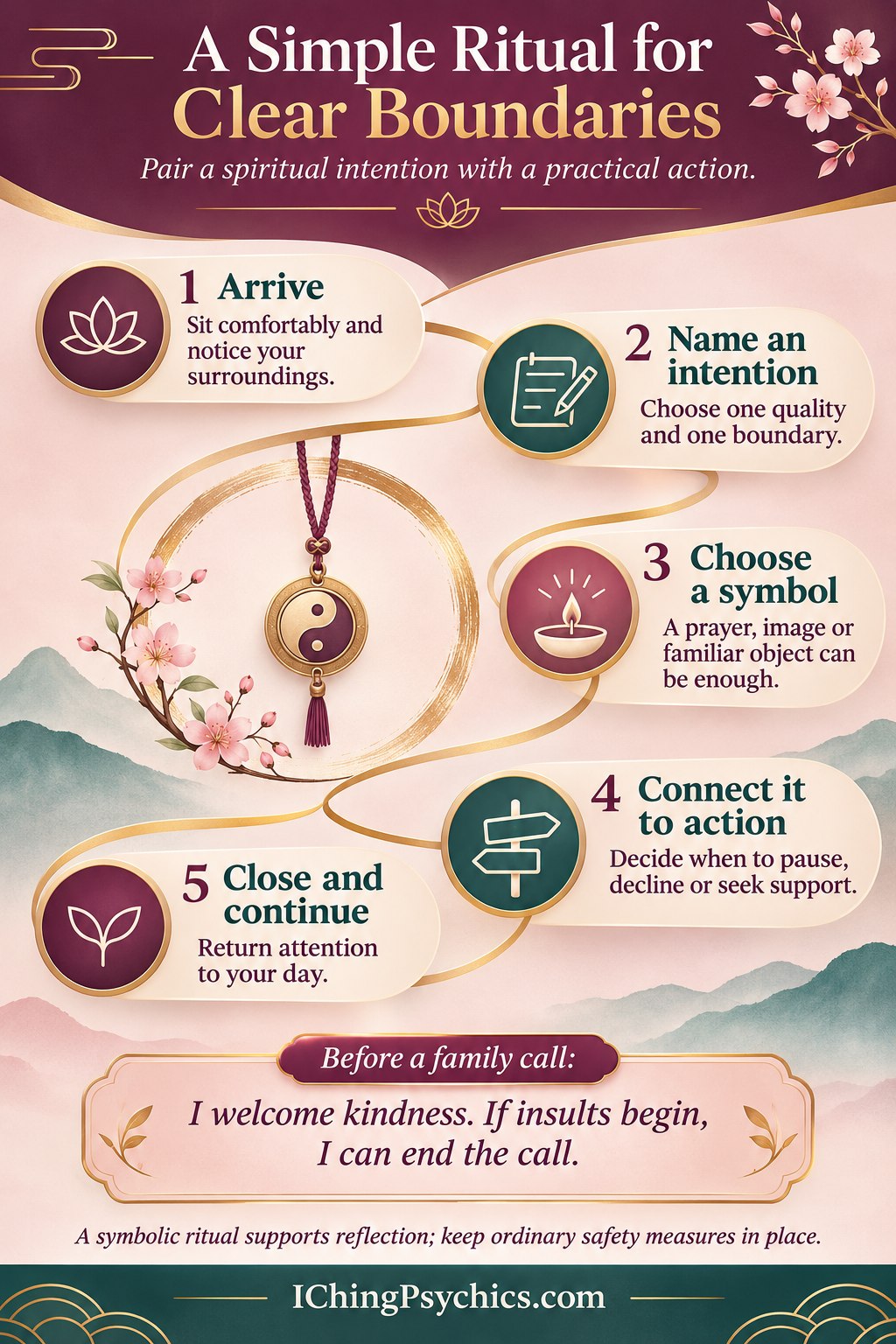
Five steps pairing a spiritual intention with a practical boundary and a clear ending.

A five-step personal protection ritual

  1. Arrive. Sit or stand comfortably. Notice the room and breathe normally. Keep your eyes open if you prefer.
  2. Name your intention. Choose one quality and one boundary: “I welcome patience, and I can end a conversation that becomes unkind.”
  3. Choose a symbol. Imagine a gentle circle of light, say a short prayer or hold an ordinary stone that has personal meaning. You do not need an elaborate image or special object.
  4. Connect the symbol to an action. Decide what you will do when a limit is reached: pause, decline, leave, ask for clarification or contact support.
  5. Close clearly. Put the object down or end with a familiar phrase. Return attention to the room and continue your day. There is no need to repeat until it feels perfect.

Four versions for different days

1. Before a difficult conversation

Intention: listen without surrendering my limits.

Action: agree on a stopping point and a way to pause if the conversation becomes too heated.

2. Before spiritual reflection

Intention: stay curious and free to question.

Action: set a short time limit, then return to ordinary activities before interpreting an impression.

3. At the end of the day

Intention: let the day’s unfinished matters rest.

Action: choose when to revisit one task, put away the device and allow the ritual to end.

4. When a practice feels too much

Intention: make room for rest.

Action: skip the ritual, use a familiar comforting routine or talk with someone you trust.

Choose tools for meaning rather than pressure

A stone, a piece of jewelry or a small image can serve as a reminder. You can choose something you already own. Its price, rarity or a seller’s claim does not establish how protected you are.

A flame-free and smoke-free practice is a simple option. It also avoids needing to burn herbs, use oils on skin or leave bowls of substances where children or pets might reach them. You do not need to ingest anything or apply a substance to your body, vehicle or home.

Respect the roots of a ritual you learn. Ask what the words and objects mean within that tradition, whether the practice is shared publicly and what adaptations are appropriate. You can decline a practice that conflicts with your beliefs or needs.

A woman holding a familiar pendant before a phone call.

Free ritual-and-boundary planner

Copy these prompts into a private note and keep the plan brief.

  1. When: one convenient moment, not a rule I must obey.
  2. Intention: the quality I want to bring to this situation.
  3. Symbol: a prayer, image or object that fits my beliefs.
  4. Boundary: what I can offer and where I will stop.
  5. Action: what I will actually do if that boundary is crossed.
  6. Review: did the practice support me, add pressure or make no difference?

Example: “Before a family call, I will pause with a familiar pendant, remind myself to speak kindly and limit the call to the time I have. If insults begin, I will end the call and decide later whether to reconnect.”

Use reflection without looking for a threat in every sign

A tiring room, a tense interaction or an unsettling dream can have many explanations. Name what happened before deciding that a person or spirit caused it. You do not need to identify an enemy for a boundary to be valid.

If you use the I Ching, an open question might be “What approach could help me keep a clear boundary here?” Our question-writing guide can help. Our decision guide keeps observations and interpretations separate.

Frequently asked questions

1. What is a daily spiritual protection ritual?

It is a repeated spiritual practice used to express an intention, connection or boundary. Its meaning varies by person and tradition.

2. Do I need to believe I am under attack?

No. You can use a ritual to remember your values and limits without deciding that an uncomfortable feeling comes from an attack.

3. Must I do it every day?

No. Choose a rhythm that fits your life. Missing a day does not establish that you are unprotected or in danger.

4. How long should it take?

A brief pause can be enough for a personal intention exercise. There is no required duration or need to repeat until it feels perfect.

5. Do I need a crystal?

No. A familiar object, a prayer or a mental image can be enough. You can also practice without any object.

6. Can I keep my eyes open?

Yes. You can look around the room and remain aware of your surroundings throughout the practice.

7. Is a light visualization a physical shield?

It can be a meaningful personal symbol, but it does not establish a physical barrier or replace ordinary safety measures.

8. Can I follow an established tradition?

Yes. Learn its context and guidance from that community. Avoid treating rites from different traditions as identical.

9. Is this the AODA Sphere of Protection?

No. The five-step exercise here is a personal intention practice. AODA teaches its own ritual template within its Druid practice.

10. Do I need smoke, candles or oils?

No. A flame-free and smoke-free practice is an option, and you do not need to apply or ingest any substance.

11. How does a ritual connect to a boundary?

Name a limit and a practical response, such as pausing a conversation, declining a request or leaving an unsafe setting.

12. Can an I Ching question help?

You can ask about your own approach and choices. Do not use an interpretation to identify a supposed attacker or dismiss a practical threat.

13. What if someone says I must pay to remove a curse?

Treat urgent, fear-based payment pressure cautiously. Pause spending, keep records and seek independent support.

14. What if the ritual makes me more anxious?

Stop or simplify it. If fear or a need to repeat becomes distressing or disruptive, seek suitable support rather than adding more ritual rules.

15. How can I tell whether the practice suits me?

Review whether it feels meaningful, neutral or burdensome and whether it supports practical choices. You remain free to change it or stop.

How to Ask Clear, Useful Questions in an I Ching Reading

Woman writing a question in a notebook beside three coins and a closed book

Quick Guide

Start with one real situation. Ask about your approach, responsibilities or missing information rather than demanding certainty about someone else. Record the wording before casting, and use the reading as reflection—not a substitute for facts or qualified advice.

On this page

One useful I Ching question helps you see a clear situation and reflect on it without pretending that uncertainty has to be removed. This concerns your approach, choices, or something you want to understand before you take action.

You don’t have to have special vocabulary, and plain language works the best. You can ask yourself how you can approach a conversation responsibly, and this gives you room to think about the question instead of just assuming you need to know what the future holds.

I Ching is a Chinese divination classic with philosophical traditions behind it. People use it in different ways, including as a spiritual practice. It hasn’t been established as a reliable method of predicting events. Asking clear questions can help you use the reading thoughtfully, and they don’t mean a guarantee.

Giving Symbols Context

Hexagrams and text lines can be broad, have images, and be unfamiliar. Without asking a clear question, it’s easy to attach their language to whatever worry you have at the moment.

If you get a reading and ask vaguely about your future, and you get imagery associated with a hard time, you might think this means your work, home, or a healthy relationship, without having any basis for this decision. Asking a specific question can narrow down the interpretive context and make it easier to see when your reading has drifted.

The Stanford Encyclopedia of Philosophy discusses the I Ching’s connection with reflection and decision-making. That historical perspective supports approaching the text as an invitation to consider conduct under uncertainty rather than expecting a complete schedule of future events.

Your question doesn’t control the answer, but it helps make the conversation more understandable. Think of this as a starting point when you’re ready to look at it, not as a finding that forces the oracle to give you the response you want.

Naming the Situation

Start with facts and describe what happened. If you’ve been offered a new role at your job, for example, and you have one week to respond, this is clearer than saying that everything is changing.

Separate facts from assumptions. An observation may suggest an explanation without proving it.

Knowing the difference helps improve the question before you cast anything. You might go from “Why is my friend punishing me?” to “How do I respond thoughtfully to this type of silence?” This changed version leaves room for more than just one explanation.

If the situation is too hard to summarize, write for a few minutes each day and then identify one issue that needs the most attention. You don’t have to fit the entire change into one reading.

Build a Clear Question

1. Name the facts

What happened, what is uncertain, and what real decision needs attention?

2. Choose your role

Focus on something you can prepare, communicate, investigate or decide.

3. Keep a record

Save the exact question and one proportionate next step. Do not rewrite it to fit later events.

Keep the Question Focused on You

Questions about what you can do usually give you more to work with because they focus on things that are actually within your control. You can prepare for something, communicate better, set boundaries, gather more information, or decide that you need more time. A reading can’t reliably tell you exactly what another person is secretly thinking or feeling.

For example, instead of asking, “Does my coworker secretly dislike me?” you could ask, “How can I improve communication in this working relationship?” Instead of asking, “Will my ex come back?” you might ask, “What should I think about as I decide how to handle this situation?”

This doesn’t mean that another person’s feelings or decisions don’t matter. It just means that a reading can’t replace actually talking to someone or paying attention to how they treat you.

It’s also important to respect other people’s privacy and boundaries. A spiritual reading shouldn’t become a reason to monitor someone, pressure them, or make decisions for them. You can be curious about another person while still respecting the things that they’ve decided to keep private.

Asking a Main Question

Try to focus on one main question at a time. If you ask, “Should I move, change jobs, end my relationship, and go back to school?” you’re really asking four completely different questions. You’re probably going to end up with an answer that’s so broad that you don’t know what to do with it.

Instead, think about which decision needs your attention first. Maybe going back to school is the first thing you need to figure out because that decision could affect where you live or what kind of job you need. You could ask something like, “What should I consider as I prepare to go back to school while keeping up with my current responsibilities?”

Sometimes different problems really do connect to one bigger issue. In that case, you could ask something like, “How can I handle all of these changes without ignoring my responsibilities?” Now you’re asking one clear question about how you want to approach everything instead of asking the reading to give you four different answers.

Once you’ve written your question, read it back to yourself. If it sounds confusing or you have to explain what you really meant, make it simpler before you start the reading. You don’t have to come up with the perfect spiritual question. You just need one that’s clear enough that you know what you’re actually asking.

Asking Practical Questions

Questions get easier when they concern a recognizable period. For example, “How can I prepare for next week’s interview?” gives a clearer focus than “How will this change my career forever?”

Tie time boundaries to real situations. It can be a period before a reply is due or a first month before a new routine. You don’t have to invent an exact date just because the reading feels more impressive with one.

A practical horizon limits overinterpretation, and getting advice about preparing for one conversation shouldn’t become a permanent rule that you can never ask a question or have a concern.

When situations change materially, a new question might be important. Repeating the same question because you don’t like the answer is different from asking about new information.

Rewriting Questions

Loaded questions assume a conclusion, such as “Why am I destined to fail?” This assumes both failure and destiny. If you ask, “What enemy is blocking me?” this assumes an enemy is an unseen attacker.

Look at the real concern. You might be afraid of making a mistake or be frustrated because something is delayed. A better question would be: What should I look at before my next attempt? How can I respond constructively to this kind of delay?

This isn’t positive thinking just to have it, but it’s about removing assumptions that have not been established. A question can look at a serious problem without giving it a supernatural cause.

You can also use the same situation when you’re making assumptions. If you’re asking, “How will my success be inevitable?” this is less useful than asking, “What responsibilities can I prepare for as the project grows?” Hope is welcome, but it shouldn’t take away from reality.

Relationship Questions That Consider Both People

When you’re asking about a relationship, try to focus on things like communication, boundaries, and how you can handle the situation. You might ask how to bring up something that’s bothering you, what expectations need to be talked about, or how you can work through a disagreement without ignoring what’s important to you.

For example, asking, “How can I talk to my partner about the different amounts of time we want to spend together?” gives you something useful to think about. Asking, “Which one of us is spiritually wrong?” doesn’t really help you solve the problem. A reading can give you something to reflect on, but it shouldn’t be used to decide that one person is automatically right and the other one is wrong.

If someone has told you that they don’t want contact, respect that boundary even if you get a reading that seems positive about the relationship. A reading doesn’t give you permission to contact someone from another account, have friends reach out for you, or pressure them to change their mind. Instead, you could ask what might help you take care of yourself and move forward while respecting their decision.

If you’re dealing with abuse or feel like you could be in danger, don’t wait for the I Ching to tell you what to do. Get help from someone who can actually help you with the situation. A spiritual practice shouldn’t be used to decide if another person is safe.

Keep Work and Money Questions Practical

The I Ching can also give you things to think about when you’re dealing with work. You might ask, “How can I explain my proposal more clearly?” or “What should I pay attention to as I take on this new responsibility?” Questions like these keep the focus on things that you can actually do.

If you’re deciding about a new job, get the real information that you need too. Find out about the pay, hours, responsibilities, location, benefits, and anything else that could affect your decision. A reading can’t tell you something that’s missing from an employment agreement or replace asking the employer for clarification.

Be especially careful about using a reading to make major financial decisions. The I Ching can’t guarantee that an investment will make money, tell you when to buy or sell something, or promise that a business will succeed. It also shouldn’t be the reason that you borrow money you can’t comfortably afford to repay.

Instead, you could use the reading to think about how you’re approaching the decision. Maybe it makes you realize that you need to slow down, look at your budget again, ask more questions, or get advice from someone who understands the financial side of the decision. The reading can give you something to think about, but the final decision should still be based on the real information that you have. See our grounded decision guide for a practical way to balance reflection with evidence.

Asking Health Questions

Do not use a hexagram to diagnose a symptom or decide on medical treatment. Those questions need qualified care.

You can reflect on the emotional side of a health situation, such as how to prepare your questions or ask for support. These questions concern your experiences, but the medical plan stays with your healthcare team.

The NCCIH’s guidance on complementary health approaches advises against delaying or replacing proven care with unproven practices. That boundary remains important even when a reading feels deeply meaningful.

If you have a symptom that needs attention, get help first. No ritual should delay getting the appropriate help that you need.

Dream and Spiritual Meaning Questions

If you like dream interpretation, an I Ching reading can offer another way to explore symbolism. Keep the layers visible so that one certain interpretation doesn’t prove another.

If you dream about a bridge, you might wonder what changes the dream brings to your mind. This question shows personal association instead of asking for a future prediction.

Write down the dream before you consult the text and include your emotions in the original context. Write down which ideas came from the dream and which ones came during the reading. This helps you avoid trying to remember the different stories if the details are in both.

It’s okay to stop with the dream itself, and adding another divination method is optional but isn’t a requirement for being spiritual.

When the Answer Doesn’t Make Sense

Sometimes you might finish a reading and have no idea what it’s trying to tell you. Before assuming that you asked the wrong question, go back and make sure that you recorded everything correctly. Check the order of the lines, which ones were moving, the hexagram number, and the instructions for whatever interpretation method you’re using. Our moving-lines guide explains the mechanics. Sometimes a simple mistake can completely change the reading.

Next, try putting the message into everyday words. If the reading seems to be about holding back, maybe ask yourself if there’s something that you need to prepare for before moving forward. If it seems to focus on cooperation, think about if there’s another person’s point of view that you haven’t considered. You don’t have to turn every symbol into a prediction about exactly what’s going to happen.

It’s also completely okay if you can see more than one possible meaning. Write both of them down and think about how each one fits with what you already know about the situation and what’s important to you. You can even decide that you don’t understand the reading yet and come back to it later. You don’t have to keep doing another reading until you finally get an answer that feels certain.

An unclear reading doesn’t mean that you’re spiritually blocked, being punished, or doing something wrong. The I Ching is an ancient symbolic text, so sometimes connecting its language to something happening in your life today just isn’t going to be simple.

Don’t Keep Asking

Hexagram Four, Meng, is often connected with the idea of being careful about asking the same thing repeatedly. That doesn’t mean that you should be scared that something bad will happen if you’re a beginner and make a mistake.

A simpler way to look at it is to pay attention to when the readings stop being helpful. If you do a reading, feel better for a little while, start worrying again, and immediately feel like you need another reading, it might be a good time to put everything away for a while.

You could make your own rule to do one reading, write down what you think about it, and take one reasonable step before asking about the same situation again. You don’t have to follow this exact rule, but having some kind of boundary can keep you from getting stuck asking the same question again and again.

If you’re dealing with so much uncertainty that it’s interfering with your everyday life, you don’t have to keep looking for answers through another reading. Talking to someone you trust or getting help from a qualified professional might give you the kind of support that you actually need.

Keeping Records

Write down the last wording before casting and leave it unchanged. If your understanding of the situation changes later, add a new note instead of replacing the original question.

This protects you from misunderstandings. A reading about how to prepare for a meeting might later be remembered as predicting the meeting’s outcome, even though this wasn’t the question. Looking at the original wording helps you see the differences.

Write down three observations, such as what it brought to mind, what information you still need, and what action you choose. The action might be asking a question or waiting for someone to reply, and this doesn’t have to be big or dramatic.

When you look at the entry later, see if the reflection was useful in the original context. This gives you more information than trying to make all the details fit into symbols. One good practice can be leaving the reading unclear until the answers come to you.

Final Thoughts: Taking Action

A useful outcome is concrete and proportionate. You shouldn’t just assume that something is guaranteed or that success will come just because a psychic said that. You also need to make sure you don’t treat hard moments as proof that the text was interpreted correctly.

Asking clear questions helps turn uncertainty into preparation. This is worthwhile, regardless of the results, even if the larger spiritual meaning is still just part of your beliefs.

Key Takeaways

  • One clear question is easier to interpret than several bundled decisions.
  • Remove assumed enemies, guaranteed outcomes and claims about another person’s hidden thoughts.
  • Use evidence and appropriate professional advice for high-stakes decisions; readings remain optional.

Frequently Asked Questions

1. What makes a useful I Ching question?

A clear situation, a manageable scope and attention to your own choices make reflection easier to use.

2. Do I need traditional language?

No. Plain wording is often clearer than trying to sound ceremonial or mystical.

3. Can I ask several unrelated questions at once?

It is usually more useful to identify which decision needs attention first and ask one focused question.

4. Must every question begin with how?

No. Wording such as what should I consider can also be useful. The scope and assumptions matter more than a formula.

5. Can a question make the answer certain?

No. Clear wording supports interpretation but does not establish reliable prediction.

6. What is a loaded question?

It assumes an unproven conclusion, such as destiny, inevitable failure or an unseen enemy.

7. How can I ask about a relationship respectfully?

Focus on communication, expectations, boundaries and your response. Do not use a reading to override another person’s refusal.

8. Can I use a reading to discover someone’s private thoughts?

A reading cannot reliably establish what another person secretly thinks or feels. Respect privacy and seek direct communication when appropriate.

9. How should I handle a job decision?

Ask about your preparation or approach while separately checking the actual terms, responsibilities and practical consequences.

10. Can I ask about health?

Reflection on support or preparing questions may be meaningful, but diagnosis and treatment decisions belong with qualified healthcare professionals.

11. Should I include a time period?

A real deadline or practical horizon can help focus the question. It does not turn the reading into a timetable of future events.

12. When might a new question make sense?

When circumstances or available information change materially. Repeating a question only to get a preferred answer is different.

13. What if the reading is unclear?

Check the recording and method, acknowledge uncertainty, and put the interpretation aside if it is not useful.

14. Why keep the original question unchanged?

It lets you compare later reflections with what you actually asked instead of adjusting the wording after events occur.

15. What is a useful way to finish?

Note what the reading brought to mind, what information you still need, and one safe, proportionate action you choose.

Moving Lines in I Ching: Reading a Changing Hexagram

Three brass coins beside a closed book and blank notebook for an I Ching reading

Quick Guide

Record six values from bottom to top. Six and nine change; seven and eight stay the same. Change all marked lines to form the relating hexagram, then follow one clearly identified interpretation method.

On this page

Moving lines are the lines in an I Ching hexagram that change from yin to yang or from yang to yin. This helps the reader to look at changes in a situation instead of just treating the reading as a fixed thing.

The mechanics are simpler than the terminology may suggest: a hexagram has six lines. Some casting results identify a line as changing, and others say that they don’t. Changing those marked lines gives a second hexagram, which is often called the relating or resulting hexagram.

Interpretation isn’t strict, and different traditions use different rules to decide which passages get the most attention, especially when the lines are changing. This guide talks about transparent beginner methods and makes those differences clear. It treats the I Ching as a traditional divination and reflection practice and isn’t a proven system for predicting events.

Structure of I Ching

The I Ching is also known as the Yijing or Book of Changes, and this is a Chinese classic that has a long history of divination and philosophical interpretations. It contains sixty-four hexagrams made from broken and unbroken lines in different arrangements.

An unbroken line is associated with the yang and a broken line with the yin. A hexagram can also be looked at as two three-line trigrams, which are a lower trigram and an upper trigram. Both the lines and the trigrams must be kept in the correct order.

The Stanford Encyclopedia of Philosophy’s account of Chinese philosophy of change explains the classic’s structure and interpretive history. It also describes divination as one way the text has been used to encourage deeper consideration of choices.

You don’t have to solve every philosophical question before you learn about the casting process. Start by keeping an accurate record. Interpretations are harder when the original line values have been lost.

The Four Possible Line Values

In regular casting methods, the results are often represented by the numbers 6, 7, 8, and 9. These numbers show the line’s initial form and whether it changes. The four values are:

  • Six is changing yin: begin with a broken line, then change it to an unbroken line.
  • Seven is stable yang: an unbroken line that stays unbroken.
  • Eight is stable yin: a broken line that stays broken.
  • Nine is changing yang: begin with an unbroken line, then change it to a broken line.

The important difference is between the line type and the line movement. Both the 6 and 8 start as yin, but only 6 changes. Both 7 and 9 start as yang, but only 9 changes.

Always write the original number beside each line. If you draw only a broken and an unbroken line, you can’t later tell which ones were moving. A small circle or cross can be helpful as a personal mark, but the numbers can give the most information for beginners.

Building the Hexagram

The first line you cast goes on the bottom, and the second one sits right above it. You continue upward until the sixth line is at the top. Line 1 is always the lowest line when you look at the text.

This can feel counterintuitive if you’re used to writing notes from the top of the page down. One easy way is to draw six numbered spaces ahead of time, with six at the top and one at the bottom and fill in the lowest space first.

If you record a sequence horizontally, label it “bottom to top” because the small note helps prevent an accidental reversal when you copy it into a diagram or write it into software.

The line order matters because a reverse figure might be a different hexagram altogether. You can have the right six values and still have the wrong text if it’s not arranged the right way.

Casting with Coins

If you use a common three-coin method, assign one side a value of 3 and the other a value of 2 before you start. You might use heads, for example, as 3 and tails as 2. Throw all the coins and then add the values to get one line.

With that assignment:

  • 3 heads = 9
  • 2 heads and 1 tail = 8
  • 1 head and 2 tails = 7
  • 3 tails = 6

Repeat the procedure 6 different times and put each result above the previous one.

Some guides use different conventions or marking systems. Use one complete method consistently and record which one you use. Don’t switch the assigned values partway through casting because the first result doesn’t seem to work.

The coin method and traditional Yarrow stalk procedures aren’t identical processes and don’t give the same probabilities for every line value. You can learn either one of these without saying that they are interchangeable, because they’re not. If you’re doing an introductory reading, accuracy and consistency are more useful than elaborate equipment.

Changing Marked Lines

After you draw the initial hexagram, make a second copy right beside it. In the second figure, change every 6 from broken to unbroken and every 9 from unbroken to broken. Leave all 7s and 8s alone on this chart.

All the marked lines change to form the relating hexagram. You don’t normally create the standard relating figure by changing one line, identifying a new hexagram, and then treating each one as a separate prediction.

Some approaches look at the intermediate structures, but that is an additional interpretation. Beginners can avoid unnecessary complexity by working with the first figure, its moving lines, and the final changing lines afterwards.

Look at your work, count the six lines in each figure, and verify that they go from bottom to top, then confirm that only the moving lines have changed. This is a mathematical way to check a diagram, and it’s not a spiritual test.

Moving Line Example

On a narrow screen, scroll the table sideways to compare all columns.

Worked example: read the cast from the bottom row upward
Line Value 1 · Qian 44 · Gou
6 (top) 7 ━━━━━━━━ ━━━━━━━━
5 7 ━━━━━━━━ ━━━━━━━━
4 7 ━━━━━━━━ ━━━━━━━━
3 7 ━━━━━━━━ ━━━━━━━━
2 7 ━━━━━━━━ ━━━━━━━━
1 (bottom) 9 ━━━━━━━━ ━━━ ━━━

This example shows how moving lines work. If you get these numbers from bottom to top: 9, 7, 7, 7, 7, 7. All six lines start out unbroken, which gives you Hexagram One, Qian. This is often called the Creative or Heaven.

The nine on the bottom is the only moving line. Since it’s moving, you change that line from unbroken to broken and leave the other five lines the same. This creates Hexagram Forty-Four, Gou, which is often called Coming to Meet or Encounter.

You can check the hexagram numbers and line positions in the Stanford Yijing overview or the Chinese Text Project. You might notice that the English names and wording aren’t always exactly the same depending on the translation you’re using. That’s completely normal. The hexagram numbers and line positions can make it easier to make sure that you’re looking at the right one.

For this example, you would pay special attention to the first line of Qian because that’s the line that changed. You can then look at Hexagram Forty-Four for another part of the reading. This can give you more to think about, but it doesn’t mean that the reading is telling you that a certain person will show up or that something will happen on a specific date.

See the Change: Hexagram 1 → Hexagram 44

Cast values, bottom to top: 9, 7, 7, 7, 7, 7.

Before: 1 · Qian

After: 44 · Gou

The outlined bottom line is line 1. Its value is 9, so it changes from yang to yin. The five lines valued 7 stay unbroken. Read the moving passage for Qian, line 1, using your chosen interpretation method.

Read the Messages in the Right Order

When you’re first learning, it can help to keep things simple. Start by reading the general meaning of your first hexagram. Then read the message for the moving line. Finally, read the general meaning of the hexagram that you ended up with after changing the moving line.

This isn’t the only way that people read the I Ching, but it’s an easy way to get started without making the reading more confusing than it needs to be.

Think about what the first hexagram might be saying about your original question. Then look at the moving line and think about what it adds or changes. Finally, look at the second hexagram and consider if it points to a different direction, a change in the situation, or something else that might be important.

Keep the question that you originally asked in front of you while you’re doing this. The meanings can be pretty broad, so it’s easy to start connecting them to things that you weren’t even asking about. For example, if your question was about preparing for a difficult conversation, there’s no reason to suddenly turn the reading into a prediction about your health.

Before looking up more interpretations, try putting the reading into your own words. Ask yourself what you think it’s giving you to consider. If you’re already confused about the basic message, adding five more interpretations probably isn’t going to make it any clearer.

Helping the Reading Be Useful

Before casting, use our guide to asking clear, useful I Ching questions to keep the reading focused on a situation and choices within your control.

If the original question was “How can I prepare responsibly to introduce a new project?” In this example, the first moving line of Qian might make you think about preparation and picking the right time to move forward. That’s just one possible way to interpret it, and it doesn’t mean that every person who gets this hexagram should read it the same way.

The idea of an encounter in the second hexagram might make you think about the other people who will be involved in the project. Maybe you need to figure out whose help you’ll need, what everyone’s role will be, or what boundaries and expectations should be clear from the beginning.

You could then turn the reading into something practical. Maybe you might decide to work on your proposal, check what resources you have available, and ask someone you trust for feedback before moving forward. These are useful things that you can actually do, even without depending on the reading to make the decision for you.

Be careful about taking a broad message and then trying to turn it into something specific. Saying, “The I Ching told me that I have to wait exactly three months,” or “This means that a dangerous person is going to come into my life,” goes much further than the reading actually tells you. You can use the reading to give you things to think about, but important decisions should still be based on the real information that you have. Our grounded decision guide explains how to check an intuitive impression against evidence and consequences.

If Many Lines Change

If you have many moving lines, it can produce passages that seem to go in different directions. This doesn’t mean that you made a mistake or that an oracle is angry at you, but it means the interpretive method matters more than ever.

Some traditions place certain lines as more important depending on the changing line number. Other readers will look at all the moving lines in the initial hexagram together with the related figure. Pick a method that’s clearly identified and use it consistently.

If you’re a beginner, try this approach: read the moving lines in bottom-to-top order and look for their roles. One passage might talk about preparation, another about conduct during action, and another about the consequences of going too far with something. Don’t try to force an agreement if you don’t understand it.

If you see two different possible readings, then write them down. Writing down uncertainty can support your answers and help you pause your interpretation and return to the practical facts of the situation.

No Changing Lines

If there are no moving lines, the hexagram remains the same, and many readers think that this is a general statement in imagery. A stable hexagram doesn’t mean that your life is permanently fixed and that nothing is ever going to change.

If all six lines move, then every line changes to the opposite, which gives a complete change in the figure’s line patterns. Interpretation still depends on the traditions that you follow.

Qian and Kun have special additional passages associated with all their lines changing in some traditional methods. These things are easy to miss if a guide presents one rule that covers every situation. Consult the instructions accompanying your chosen translation when this happens.

You don’t have to memorize every exception before you do your first reading, but keep the numbers, identify the figures correctly, and use a source that explains why it went that way instead of changing a rule after you see the results.

Avoiding Common Mistakes

Mechanical errors are reversing the line order, changing stable lines, and confusing upper and lower trigrams. Keeping careful records causes less confusion than repeatedly recasting the same question over and over again.

Another mistake can be reading the moving line passage from the relating hexagram when your picked method calls for the initial hexagram’s passage. Different methods might use different texts, but accidentally switching isn’t interpreting or following tradition.

Repeated casting can become a way to look for reassurance, but if you keep asking until the result is favorable to you, it is hard to know what you’re really learning. Write down the first reading and take one reasonable action before you consider a new question.

Don’t treat alarming traditional language as a literal forecast. Words connected with loss, danger, or misfortune need context for interpretation. These aren’t a basis for diagnosing illnesses or accusing another person.

Compare Translations

Different English translations can have the same passage that sounds practical, poetic, spiritual, or severe. It’s up to the translator and the commentary to influence your response.

Pick one edition as your starting point and then know the difference between the translation and the author’s added explanation. If the passage is still unclear, look at another translation. Write down the change in wording instead of looking at the second book as a new casting.

Always be cautious about removing uncomfortable historical language without acknowledging it. Old texts can have assumptions about gender, hierarchy, and social roles that need to be interpreted today. You can reject a harmful application but still look at the passage seriously.

A translation comparison should clarify the reading and not become a search for reassurance. If different commentaries leave you more confused, go back to your original question and the facts of the situation. You can put the interpretation aside and still make your own decisions.

Final Thoughts: Having Useful Readings

End your reading with a short note that includes your question, values, moving lines, relating hexagrams and an interpretation. Add one action that is safe, proportionate and supported by ordinary judgement.

Later, look at the note without rewriting what you originally meant. Pay attention to what helped and what didn’t, and what is still uncertain. This habit makes it more reflective and less dependent on hindsight.

Moving lines invite reflection on change. Their value comes when careful mechanics lead to good questions. Let the reading get your attention while the decisions stay connected to evidence, consent, and the circumstances you can observe.

Key Takeaways

  • Cast and number lines from the bottom upward.
  • Changing yin is 6; changing yang is 9. Do not change stable 7s or 8s.
  • Interpretive traditions differ, especially for multiple moving lines. Keep the method and original record clear.

Frequently Asked Questions

1. What are I Ching moving lines?

They are lines designated as changing: yin becomes yang or yang becomes yin in the relating hexagram.

2. Which values change?

Six and nine change. Seven and eight remain stable.

3. What does a six mean?

Six is changing yin: draw a broken line in the initial hexagram, then an unbroken line in the relating figure.

4. What does a nine mean?

Nine is changing yang: draw an unbroken line initially, then a broken line in the relating figure.

5. Where does the first cast go?

At the bottom. The sixth cast is the top line.

6. How many lines make a hexagram?

Six. Record exactly six results and preserve their bottom-to-top order.

7. How do the three coins produce a number?

In the convention used here, heads is 3 and tails is 2. Add the values of three coins for each line.

8. Can I reverse the heads and tails assignment?

Some methods use different conventions. Choose a complete method before starting and use it consistently.

9. Do all moving lines change at once?

To construct the standard relating figure, change every marked line and leave all stable lines alone.

10. Does the relating hexagram guarantee the future?

No. It is part of an interpretive practice, not an established prediction of what must happen.

11. What if no lines move?

The line pattern remains unchanged. That does not mean your circumstances can never change.

12. What if every line moves?

Every line changes to its opposite. Follow your chosen edition’s interpretation rules, including any special passages for Qian and Kun.

13. Which hexagram supplies the moving-line text?

The beginner approach here uses moving-line passages from the initial hexagram. Other methods may differ; do not switch accidentally.

14. Why do different guides prioritize different lines?

There is more than one interpretive tradition. Consistency and an explicit method are more useful than changing rules to get a preferred answer.

15. Should I cast again until I like the result?

Repeated casting can become reassurance-seeking. Record the first reading, acknowledge uncertainty and return to practical information.

Intuition in Uncertain Times: A Grounded Decision Guide

Person comparing options with a journal and compass

Uncertainty makes certainty feel valuable, which is why a sudden gut feeling can seem like rescue. Intuition may reflect rapid pattern recognition, learned experience, emotion, or a values conflict you have not yet named. It can also reflect fear, habit, prejudice, or incomplete information. The wise approach is neither to worship intuition nor dismiss it: notice the signal, identify its possible source, and test it in proportion to the stakes.

Quick Guide

PauseWrite the intuitive message in neutral words
ExplainList pattern, emotion, value, and bias hypotheses
TestSeek evidence and a disconfirming view
ChooseMatch decision speed to consequence and reversibility

What a gut feeling can be

Intuition often arrives before a verbal explanation. An experienced person may recognize a familiar configuration quickly; your body may register tension before your narrative catches up; or a choice may conflict with a value you have ignored.

None of those possibilities makes the feeling infallible. The content still needs examination.

Turn the feeling into a testable sentence

Replace “Something is wrong” with a specific observation: “The terms changed twice,” “I feel rushed,” or “This option gives me no exit.” Specific language separates data from atmosphere and reveals what information is missing.

If you cannot name evidence, keep the intuition as a caution flag rather than a verdict about another person.

The four-source check

Ask whether the signal could come from expertise, emotion, values, or bias. Expertise is strongest in familiar environments with feedback. Emotion can reveal importance but may narrow attention. Values tell you what matters, not what will happen. Bias can make familiarity feel true even when it is wrong.

More than one source can be active at the same time.

Use stakes to choose the method

For a reversible, low-cost choice—such as which creative idea to try—intuition can lead and feedback can correct. For a high-cost or irreversible choice involving health, law, money, safety, or major commitments, gather evidence and qualified advice.

Urgency created by a salesperson or manipulative person is not the same as a genuine emergency.

Invite disconfirmation

Ask what evidence would change your mind. Seek one credible view that disagrees. Check base rates, contracts, dates, and independent records. If your intuition survives serious scrutiny, you understand it better; if it changes, the process protected you.

A trusted person can help spot a fear loop or a rationalization you cannot see alone.

A short decision ritual

Write the choice, options, deadline, and worst plausible consequence. Take one quiet minute. Record the first felt preference without editing. Then list evidence for and against, the smallest reversible test, and the person whose expertise is relevant.

End with a review date. Good decisions are sometimes updated when new information arrives.

Continue Exploring

Frequently Asked Questions

Is intuition psychic?

Some people interpret intuition spiritually; psychology also describes rapid, nonconscious judgment. Neither framing makes every intuition accurate.

How do I tell intuition from anxiety?

Anxiety often repeats urgent threat scenarios, while intuition may be quieter—but this is not a reliable diagnostic rule. Examine evidence and patterns.

Should I trust my gut about a person?

Treat it as a safety cue and slow down, especially if you feel pressured. Avoid turning it into an unsupported accusation.

When is intuition most reliable?

It tends to be more useful in familiar domains where you have substantial experience and receive clear feedback.

Can bias feel intuitive?

Yes. Stereotypes and familiarity can produce fast, confident judgments.

What if facts and intuition disagree?

Recheck the facts and the feeling. For high-stakes choices, do not ignore reliable evidence or qualified advice.

Can the I Ching make the decision for me?

Use it as a reflective framework, not an authority that removes responsibility for consequences.

How long should I wait?

Match time to urgency and reversibility. Do not let artificial pressure erase due diligence.

Sources and Method

This article distinguishes reflective or spiritual interpretation from established evidence and uses the following sources for factual health or research claims:

Which Psychic Website Has the Best Psychics in 2026?

Which Psychic Website Has the Best Psychics

Quick Verdict

For readers looking for screened psychics, multiple reading formats, transparent pricing, and a curated advisor network, PsychicOz is one of the strongest overall choices in 2026. However, California Psychics, Psychic Source, Keen, Kasamba, and Purple Garden each have strengths that may appeal to different types of users. The best website ultimately depends on whether you value advisor screening, relationship specialists, budget-friendly readings, or a large selection of psychics.

Article Outline

  • Quick Verdict
  • Comparison Table
  • How We Evaluated These Websites
  • Top Psychic Websites Reviewed
  • Pricing Comparison
  • Screening Comparison
  • Customer Review Analysis
  • Best For Different Types of Users
  • Who Should Choose Each Website?
  • Frequently Asked Questions
  • Final Recommendation

Finding a Psychic Site is Easy

Finding a psychic site is easy, but finding one that has skilled psychics is harder. There are many psychic sites that advertise thousands of advisors, training, monitoring, quality of the screening process, and customer satisfaction, but the quality can change depending on the site.

This guide compares well-known psychic sites and looks at different factors that matter the most when evaluating the quality of psychic websites.

Comparison Table

Feature PsychicOz California Psychics Psychic Source Keen Kasamba Purple Garden
Phone Readings Yes Yes Yes Yes Yes Yes
Chat Readings Yes Yes Yes Yes Yes Yes
Video Readings Yes Limited Limited Limited Limited Yes
Email Readings Yes Some Some Some Some No
Screening Process Extensive Extensive Extensive Moderate Moderate Moderate
Relationship Specialists Yes Yes Yes Yes Strong Focus Yes
Mobile Experience Strong Good Good Good Good Strong
Advisor Network Size Curated Large Large Very Large Large Medium
Best For Balanced Quality Established Reputation Customer Support Variety Love Readings Mobile Users

How We Compared These Psychic Websites

There are a lot of psychic websites available today, so we focused on several factors that can have a real impact on the client experience. Here are some of these:

Advisor Screening

One of the first things we looked at was how advisors are evaluated before joining a platform. Some websites use interviews, evaluation readings, and ongoing reviews, while others focus more on building a large advisor directory.

Advisor Quality

We also considered advisor experience, specialties, client feedback, and overall reputation. While no advisor is the perfect fit for everyone, strong feedback and consistent reviews can often be good signs.

Client Experience

A positive experience involves more than just the reading itself. We looked at things like ease of use, available reading formats, pricing transparency, and customer support.

Client Feedback

Reviews can provide helpful insight into what real clients experience. While every reading is different, feedback patterns can often reveal strengths and weaknesses that may not be obvious at first glance.

Top Psychic Websites Reviewed

Here are some of the top psychic websites reviewed:

PsychicOz

Best For

People who want a combination of advisor screening, multiple reading options, and transparent pricing.

What People Like

  • Curated advisor network.
  • Phone, chat, video, and email readings.
  • Transparent pricing.
  • Multiple specialties.
  • Focus on advisor quality.

Things to Know

  • Smaller advisor network than some competitors.
  • Certain specialists may occasionally have limited availability.

Pricing

The platform offers introductory options along with a variety of advisor rates.

Here’s What Stands Out with PsychicOz

PsychicOz


PsychicOz focuses on maintaining a carefully selected network of advisors. The platform places a strong emphasis on advisor evaluations, interviews, and ongoing monitoring while still offering several ways for clients to connect with readers.

Client Feedback

Many reviews mention professionalism, advisor consistency, and the ability to find specialists for topics such as relationships, career guidance, and spiritual growth.

California Psychics

Best For

People who prefer an established psychic platform with a long history in the industry.

What People Like

  • Long-standing reputation.
  • Large advisor network.
  • Advisor ranking system.
  • Detailed advisor profiles.

Things to Know

  • Higher-tier advisors can be more expensive.
  • Comparing advisors may take additional time.

Pricing

Rates vary depending on the advisor’s experience level and ranking.

Here’s What Stands Out with California Psychics

California Psychics is known for its advisor-tier system and long history of serving clients. Many users appreciate being able to compare advisors based on experience and demand.

Client Feedback

Positive reviews often focus on advisor professionalism, experience, and specialty knowledge.

Psychic Source

Best For

Clients who value customer support and easy advisor selection.

What People Like

  • Strong customer service.
  • Good advisor variety.
  • Multiple reading categories.
  • Established reputation.

Things to Know

  • Some highly experienced advisors charge higher rates.

Pricing

Pricing varies based on the advisor and specialty selected.

Here’s What Stands Out with Psychic Source

Psychic Source combines advisor screening with strong customer support. The platform has built a reputation around helping clients find readers who match their interests and goals.

Client Feedback

Many reviews mentioned fast and responsive customer service and advisors who communicate clearly and professionally.

Keen

Best For

People who enjoy having a large number of advisors and specialties to choose from.

What People Like

  • Huge advisor network.
  • Wide variety of specialties.
  • Flexible pricing.
  • Extensive client reviews.

Things to Know

  • Advisor quality can vary.
  • Research is often important before choosing a reader.

Pricing

Keen offers one of the widest pricing ranges in the industry.

Here’s What Stands Out with Keen

Keen gives clients access to a massive advisor marketplace. This can be appealing for people who enjoy comparing readers, exploring specialties, and reviewing client feedback before booking.

Client Feedback

Many users appreciate the variety, although experienced clients often recommend spending time reading reviews before making a selection.

Kasamba

Best For

People seeking relationship guidance, dating advice, and emotional support.

What People Like

  • Relationship specialists.
  • Large advisor network.
  • User-friendly platform.
  • Long industry history.

Things to Know

  • The platform focuses heavily on relationship topics.

Pricing

Pricing varies across advisors and specialties.

Here’s What Stands Out with Kasamba

Kasamba has built much of its reputation around love and relationship readings. Many clients visit the platform specifically for help with breakups, communication concerns, compatibility questions, and emotional clarity.

Client Feedback

A large portion of the positive feedback focuses on relationship guidance and emotional support.

Purple Garden

Best For

People who enjoy video readings and mobile-friendly experiences.

What People Like

  • Modern platform design.
  • Strong mobile experience.
  • Video reading options.
  • Easy-to-use app.

Things to Know

  • Smaller advisor network than some larger marketplaces.

Pricing

Moderate pricing across a variety of reading categories.

Here’s What Stands Out with Purple Garden

Purple Garden is especially popular with clients who enjoy video communication and managing their readings through a smartphone app. The platform focuses on creating a simple and convenient experience.

Client Feedback

Many users mention convenience, ease of use, and the platform’s mobile-friendly design.

Pricing Comparison

Website Introductory Offer Typical Reader Range Premium Reader Range
PsychicOz Available Low-Mid Mid-High
California Psychics Available Mid High
Psychic Source Available Mid High
Keen Available Low-High High
Kasamba Available Low-Mid High
Purple Garden Available Mid Mid-High

Screening Comparison

Website Application Review Test Readings Ongoing Monitoring
PsychicOz Yes Yes Yes
California Psychics Yes Yes Yes
Psychic Source Yes Yes Yes
Keen Yes Limited Varies
Kasamba Yes Moderate Moderate
Purple Garden Yes Moderate Moderate

Customer Review Analysis

When looking at customer feedback, here are some patterns to look for:

  • Curated networks that are known for their consistency.
  • Large networks that are known for their variety.
  • Relationship psychics that get strong feedback for their romantic topics.
  • Customers who value customer support and transparency as much as a psychic’s ability.

Best Websites for Different Types of Clients

Here are some of the best websites for different types of clients:

Best Overall

PsychicOz

PsychicOz stands out for its combination of advisor screening, multiple reading formats, transparent pricing, and a user-friendly experience. It offers a good balance of flexibility and quality control, which appeals to a wide range of clients.

Best Established Brand

California Psychics

California Psychics is one of the longest-running names in the industry. Many clients appreciate its reputation, advisor ranking system, and large selection of readers.

Best Customer Support

Psychic Source

Psychic Source has built a strong reputation for customer service and advisor selection tools. It may be a good choice for clients who value support throughout the booking process.

Best Variety

Keen

Keen offers one of the largest advisor directories available. Clients who enjoy comparing readers, specialties, and pricing options often appreciate the amount of choice available on the platform.

Best Love Readings

Kasamba

Kasamba is well known for relationship guidance and emotional insight. Many clients choose the platform specifically for dating questions, breakups, communication concerns, and relationship clarity.

Best Mobile Experience

Purple Garden

Purple Garden is popular among clients who prefer managing readings through a smartphone app. The platform’s mobile-friendly design and video reading options make it appealing for users who want a modern experience.

Which Website Might Be Right for You?

Here are some of the websites that might be right for you!

Choose PsychicOz If:

You want a balance of advisor screening, multiple reading options, transparent pricing, and a curated advisor network.

Choose California Psychics If:

You prefer an established platform with a long history and a large selection of advisors.

Choose Psychic Source If:

Customer support, advisor quality, and an easy booking experience are important to you.

Choose Keen If:

You enjoy having a large number of advisors, specialties, and pricing options to explore.

Choose Kasamba If:

Your main focus is love, dating, relationships, and emotional guidance.

Choose Purple Garden If:

You prefer a mobile-friendly platform and enjoy video readings and app-based communication.

Final Thoughts: Finding the Perfect Psychic Site

No psychic site is going to be perfect for everyone, but the sites that have good advisor screening, transparent pricing, positive client feedback and reviews, and different reading formats give a strong overall reading experience.

Clients who look for a balance between screening, accessibility, and advisor consistency might turn to PsychicOz for the best reading experience. Those who want a larger advisor pool might choose Keen, and those who are focused more on relationship readings might pick Kasamba. Of course, don’t forget California Psychics and Psychic Source as options for those who want a site that has established its brand and has structured advisor selection systems.

The best way to pick a site is to identify your goals and your needs, and then pick a site that matches those needs.

Frequently Asked Questions

Here are some frequently asked questions:

Which psychic website has the best psychics?

The best website often depends on your personal preferences. Many clients look for advisor experience, communication style, specialties, and client reviews when choosing a psychic.

How are psychics screened?

Screening processes vary by platform. Some websites use applications, interviews, evaluation readings, and ongoing performance reviews before allowing advisors to offer readings.

Are online psychic readings accurate?

Experiences can vary from person to person. Many clients find readings helpful for gaining insight, perspective, and clarity about situations in their lives.

What is the difference between phone and chat readings?

Phone readings allow for real-time conversation, while chat readings provide written communication that clients can review later. The best option usually comes down to personal preference.

Are video readings better than phone readings?

Not necessarily. Some people enjoy face-to-face interaction through video, while others prefer the privacy and convenience of a phone reading.

Which website is best for relationship readings?

Many clients choose platforms like PsychicOz and Kasamba when looking for relationship guidance, dating insight, and emotional support.

Which website has the most psychics?

Keen is often recognized for having one of the largest advisor directories and the widest selection of specialties.

Can I get an email reading?

Some platforms offer email readings, allowing clients to receive written guidance that they can revisit later.

How much do psychic readings cost?

Pricing varies based on the platform, advisor experience, reading format, and specialty.

What should I ask during a reading?

Many clients ask about relationships, career decisions, personal growth, family concerns, or specific situations they are currently facing.

How do I choose a psychic?

Reading reviews, comparing specialties, and finding an advisor whose communication style feels comfortable can help you find a good match.

What is a psychic medium?

A psychic medium focuses on perceived communication with loved ones who have passed away and may offer spiritual guidance during readings.

Are tarot readings available on all websites?

Most major psychic websites offer tarot readings, although the number of tarot specialists may vary from one platform to another.

Can I read customer reviews before booking?

Most established psychic websites provide advisor reviews and ratings to help clients make informed decisions.

How often should I get a psychic reading?

The answer depends on your personal goals and preferences. Some people get readings regularly, while others only seek guidance during important life situations.

Are psychic readings confidential?

Most reputable platforms have privacy policies and security measures designed to help protect client information.

What if I am not satisfied with my reading?

Many websites offer customer support and may have satisfaction policies in place. It is always a good idea to review those policies before booking.

Which website is best for beginners?

Many first-time clients prefer websites that offer advisor screening, clear pricing, and easy-to-use platforms.

Do experienced psychics cost more?

Sometimes. Advisor experience, popularity, specialties, and demand can all affect pricing.

What makes a psychic website trustworthy?

Many clients look for advisor screening, transparent pricing, secure payment systems, customer support, client reviews, and a strong reputation when evaluating a psychic website.

What Defines a Toxic Relationship and How to Break Free

What Defines a Toxic Relationship and How to Break Free

Toxic relationships can develop slowly and often begin with small patterns that don’t immediately raise any type of concern. What might feel like a normal disagreement or emotional intensity can slowly change into repeated cycles of control, emotional strain, and negativity. As time goes on, these patterns can become deeper and make it harder to see how much the relationship is affecting your life.

These relationships can be followed by behaviors like unhealthy communication, control, a lack of support, jealousy, betrayal, and dishonesty.

As these patterns continue, they can take a toll on a person’s overall mental and emotional well-being and lead to anxiety, stress, self-doubt, and even isolation. The longer this situation continues, the more it can shape how a person sees themselves and their ability to trust others.

If you are in immediate danger, call local emergency services. If you are worried about how someone may react to a boundary or to your leaving, contact a trusted person or a domestic abuse support service from a device you can use privately. In the U.S., the National Domestic Violence Hotline can help you make a safety plan.

By knowing the difference between a normal relationship challenge and ongoing toxicity, you can realize that every relationship has hard moments, but that toxic relationships are about consistent harm instead of occasional conflict. By recognizing these signs early, you have the opportunity to take action. This means setting boundaries, getting support, or making a decision about the future of the relationship.

Understanding a Toxic Relationship

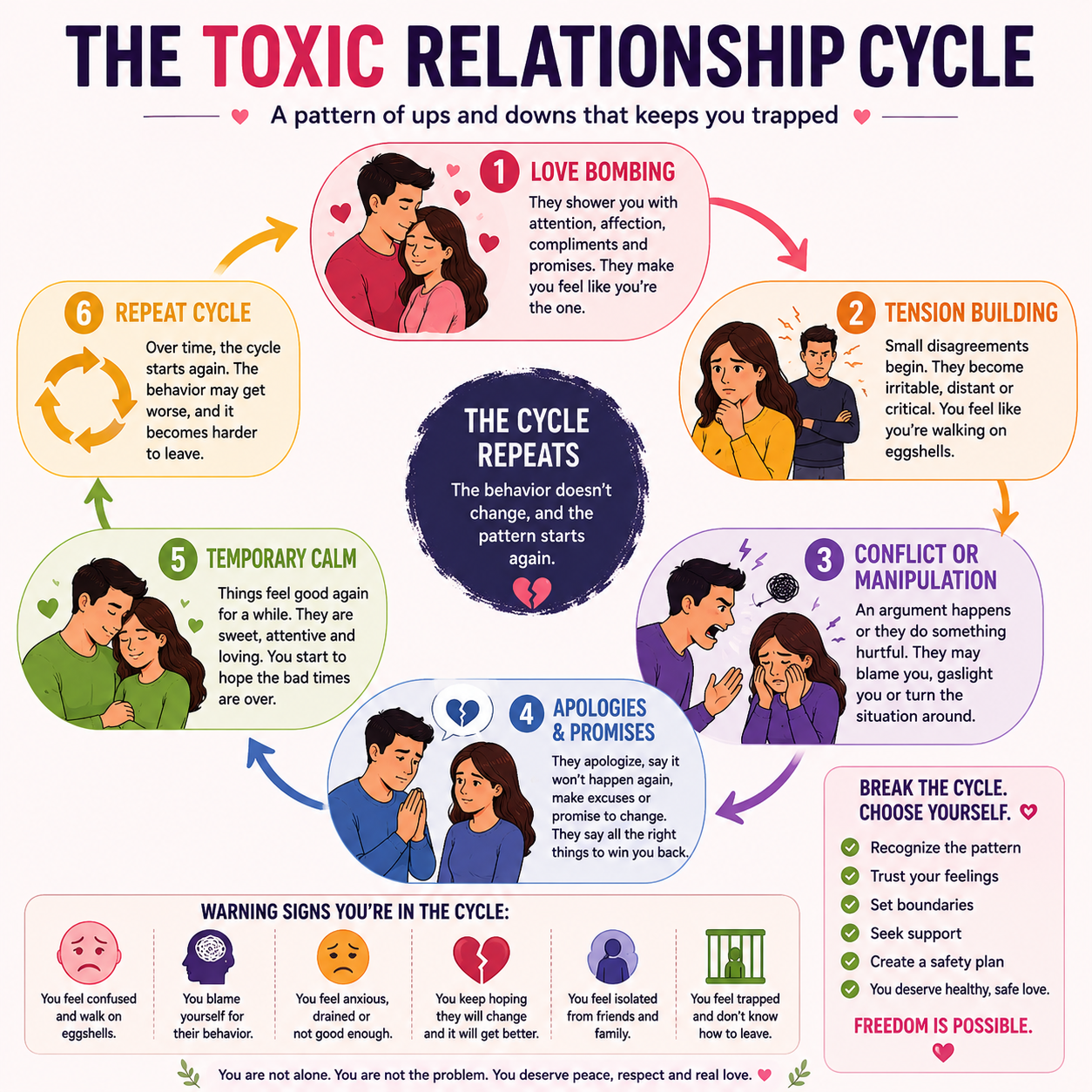
The diagram shows one pattern a person may experience. You can seek support after a single threat or act of violence, at any point in the relationship.

Toxic Relationship Cycle

A toxic relationship is one where the dynamic is harming one or both partners physically, mentally, or emotionally. Instead of supporting each other, valuing each other, or respecting each other, one or both partners feel confused, drained, or exhausted as time goes on.

In a healthy relationship, both partners help make sure each other’s overall well-being is healthy and strong. In toxic relationships, however, there’s an imbalance where one partner might take on more than they give, or the relationship might become about criticism, control, or emotional instability.

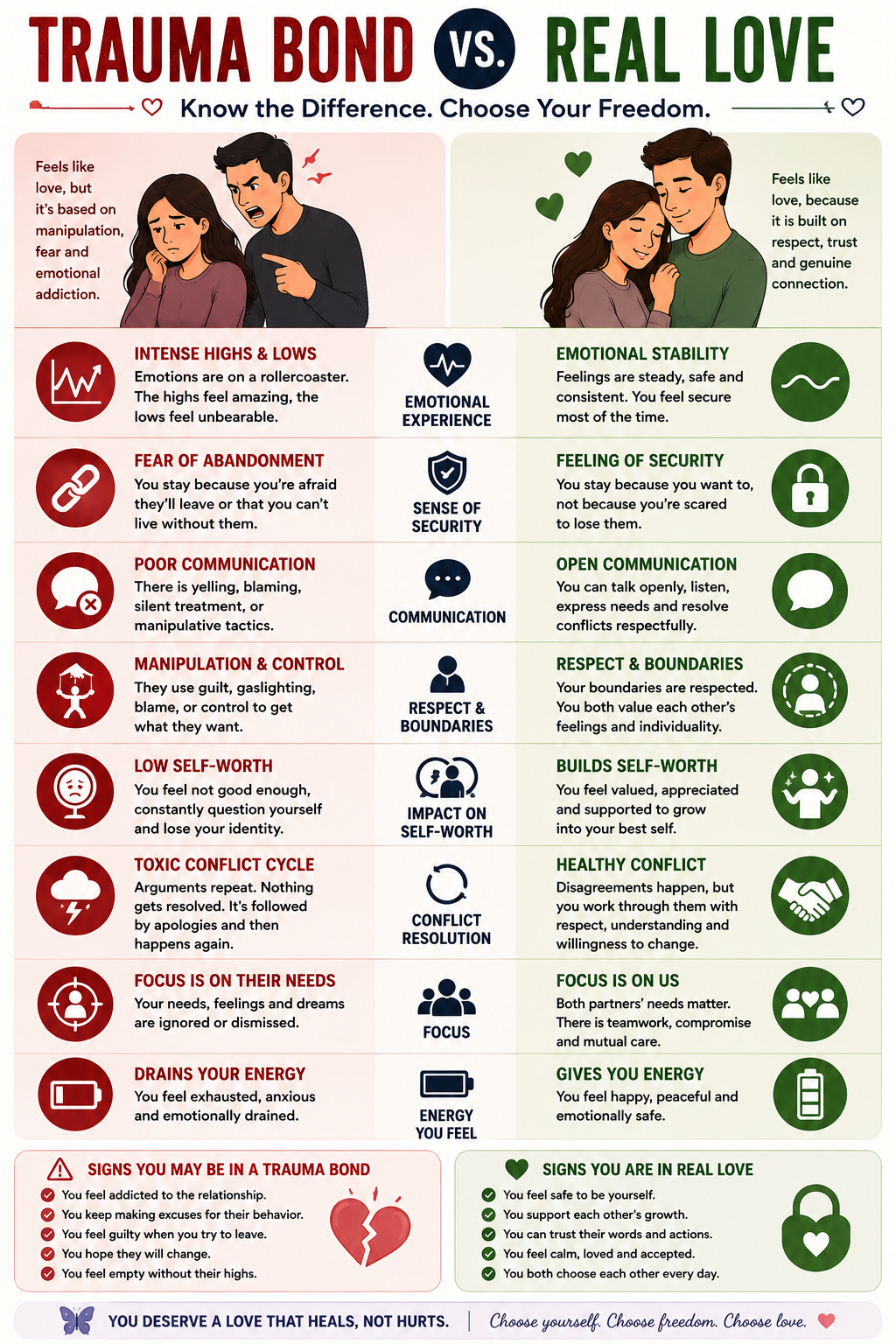
Toxic vs. Difficult Relationships

Trauma Bond vs Real Love

It’s important to understand that all relationships go through challenges, and not all challenging relationships mean they’re toxic. Some relationships go through hard periods, especially during times of change or extreme stress.

A difficult relationship can look like:

  • Occasional conflict or misunderstandings.
  • Space for communication and resolution.
  • An effort from both partners to improve the relationship.

A toxic relationship can look like:

  • Repeated harmful behaviors without wanting to change.
  • Lack of accountability.
  • Not willing to grow.
  • Ongoing emotional distress or instability.

Ask what happens when either person says no, shares an opinion, spends time with friends or makes an independent decision. A difficult conversation can leave both people upset while still giving them the freedom to disagree. Threats, monitoring, isolation and control of money or movement are reasons to seek support. A single threat or act of violence is enough to take your safety seriously.

Common Signs of a Toxic Relationship

Here are some common signs of a toxic relationship:

Lack of Support

In a toxic relationship, one partner may stop the other from being independent or discourage outside connections. This might feel small at first, with a subtle comment or a request, but it can eventually lead to reduced contact with friends and family.

As time goes on, this kind of isolation can make it harder to get the support or perspective that you might need. You might start relying more on your partner for emotional validation, which makes you more dependent and makes it harder for you to get away from the relationship if needed.

Toxic Patterns

Communication in a toxic relationship usually becomes unproductive, negative, or emotionally damaging. Conversations might include defensiveness, avoidance, emotional shutdown, or criticism.

Instead of being able to fix these issues, these patterns can go into conflict, or the problems might just be unresolved. As time goes on, this creates a communication environment where one or both partners feel misunderstood, constantly on edge, or unheard.

Jealousy and Controlling

When there’s jealousy in a toxic relationship, it goes beyond insecurity. This can often lead to controlling behavior, such as questioning your decisions, limiting your independence, and watching your actions.

At first, these behaviors might seem like concern or care, but they often create a place where one partner feels restricted or pressured. This can lead to stress, less confidence, and a loss of personal freedom.

Manipulation and Control

Manipulation can look like different things, such as:

  • Guilt tripping.
  • Distorting the situation.
  • Shifting responsibility.
  • Gaslighting.

As time goes on, this can cause you to question whether your experiences or thoughts are true. You might start to doubt your judgment or feel responsible for problems that are not entirely your own.

Types of Toxic Partners and What They Can Do to You

Not every unhealthy relationship looks the same. Sometimes the patterns are subtle at first, but over time, they start to affect how you feel, think, and show up in your own life.

Types of Toxic Partners

This partner constantly points out what’s wrong—whether it’s your choices, your personality, or small things that shouldn’t matter.

It might start off as jokes or “helpful comments,” but over time, it can wear down your confidence and make you question yourself.

Using Guilt

This person has a way of making you feel responsible for how they feel.

You might notice:

  • Feeling guilty for things that aren’t really yours to carry.
  • Changing your behavior just to avoid upsetting them.

Over time, this creates an imbalance and quiet resentment.

Playing a Victim

This partner avoids taking responsibility by always turning the situation around.

Instead of owning their part, they:

  • Blame you.
  • Act misunderstood.
  • Make it hard to actually solve anything.

This creates a cycle where nothing ever really gets resolved.

Focusing On Their Own Needs

This is the partner who focuses mostly on their own needs and perspective. You may feel like:

  • Your feelings aren’t fully heard.
  • Your experiences don’t matter as much.

Over time, this creates distance and imbalance in the relationship.

Physical Effects of Stress

Stress doesn’t just stay emotional, but it can affect your body, too. You might notice things like:

  • Trouble sleeping.
  • Feeling run down or constantly tired.
  • More stress-related symptoms are showing up.

When stress becomes constant, your body feels it.

Emotional and Mental Impact of Toxic Relationships

Toxic patterns can slowly change how you feel about yourself. Common experiences include:

  • Ongoing anxiety or stress.
  • Feeling emotionally drained.
  • Lower self-confidence.
  • Questioning yourself more than you used to.

Over time, this can affect how you see yourself and how you approach future relationships.

Creating Distance from Those Around You

Sometimes, toxic relationships create distance between you and the people around you. This can happen because:

That distance can make things feel even more isolating.

Pay Attention to Your Own Feelings

Sometimes the clearest signs show up in how you feel. You might notice:

  • Feeling anxious before or after seeing them.
  • Holding back what you really want to say.
  • Feeling like you have to be careful all the time.
  • Doubting your own thoughts or reactions.

Those feelings usually point to something deeper going on.

Boundaries Matter

Boundaries are the limits you put in place to protect your well-being. They help you decide:

  • What you are okay with.
  • What you are not okay with.
  • What steps you can take to protect your privacy and well-being.

What Healthy Boundaries Do

Healthy boundaries help to create things like:

  • A stronger sense of self.
  • More respect in the relationship.
  • Better emotional balance.
  • Clear expectations between both people.

Without them, unhealthy patterns tend to continue.

How to Set Boundaries

When you can speak freely and disagree safely, a boundary can give you an action you control. Possible actions include the following.

  • Saying clearly what you need.
  • Following through when something crosses a line.
  • Taking space when necessary.

If the other person threatens you or punishes you for disagreeing, consider speaking privately with an advocate before announcing a change. The other person is responsible for their behavior. You can seek help even if you have tried several ways to set a boundary before.

Getting Support When Needed

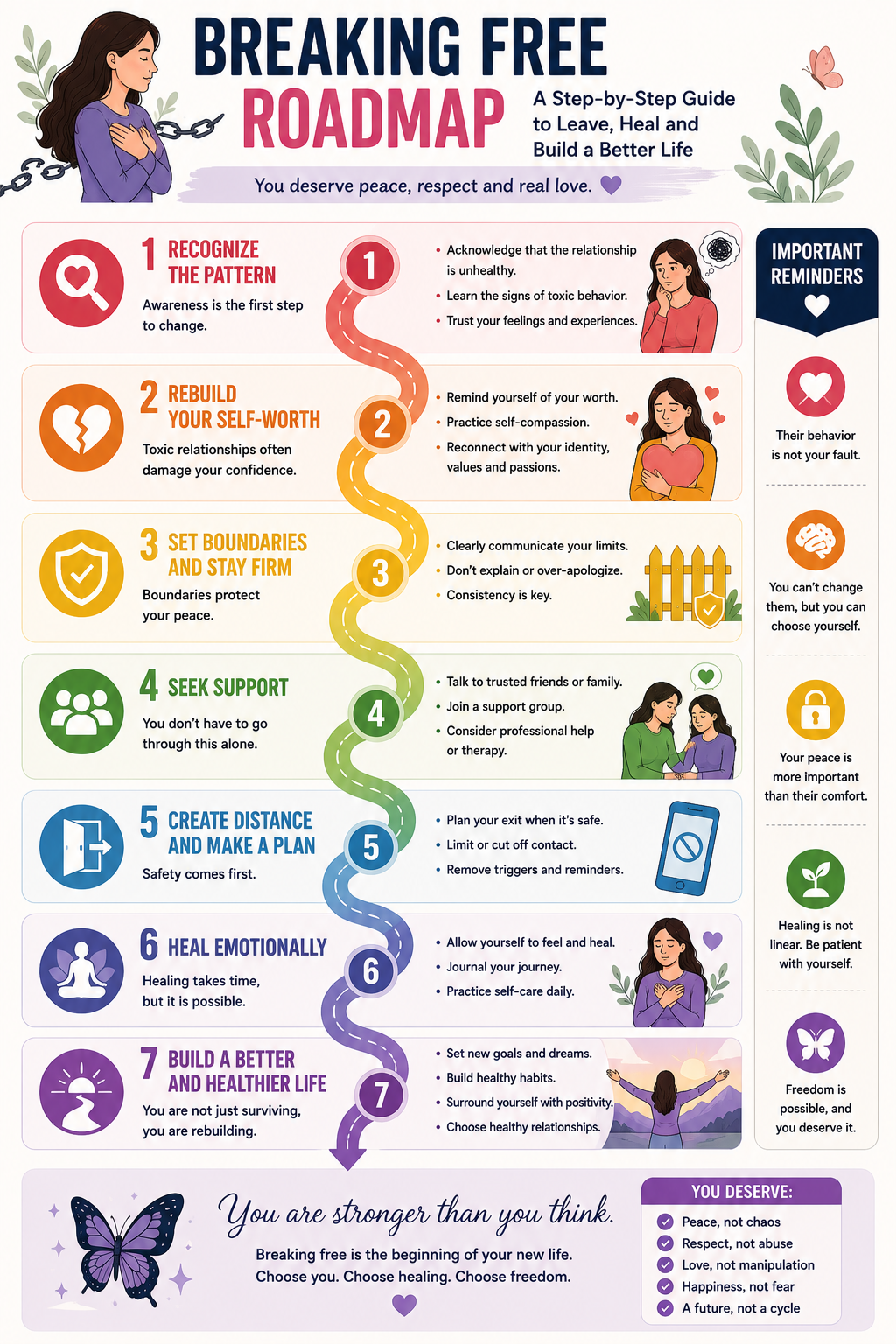
If there have been threats, violence or monitoring, speak privately with a support service before announcing a boundary or changing contact. A personal safety plan can come before any of the other steps shown in the roadmap.

Breaking Free Roadmap

If both people can speak freely and take responsibility for how they behave, a qualified professional can help them work on the following steps.

  • Identify patterns that keep repeating.
  • Improve how you communicate.
  • Start rebuilding trust in a healthier way.

If you fear retaliation, start with confidential, individual support. The Hotline’s guidance on couples counseling when abuse is present explains why a joint session can carry risks. Explain what the other person does when you disagree and ask what options fit your circumstances. The first call can be about understanding your choices.

Toxic relationships don’t always start out obviously. A lot of times, the patterns build slowly over time. Paying attention to how you feel, setting boundaries, and being honest with yourself are the first steps toward change.

You deserve a relationship that creates support, respect, and emotional balance—not one that leaves you feeling drained or unsure of yourself.

When It’s Better to Leave a Relationship

Repeated harm, fear or escalating control are reasons to get support. An advocate can help you plan for the time before, during and after a separation. Think through whom to contact, where you could go, and how to get there if you had to leave quickly. A private conversation with an advocate can help you weigh shared housing, children, pets, medication or finances. If you need urgent help, use local emergency services.

Healing After a Toxic Relationship

Healing starts with understanding what you went through. By looking at the patterns, you can get clarity and avoid repeating the same dynamics in future relationships.

Finding a Support System

Find people that you can connect with who give positive support. Strengthen these connections so that you can have balance and emotional stability in your life.

Restoring Your Own Identity

Take time to discover who you are outside the relationship. Focus on things such as:

  • Your individual goals.
  • Your overall emotional well-being.
  • Your personal interests.

These things will help to rebuild your confidence and help you to grow as an individual.

Finding Healthier Relationships

Knowing what a healthy relationship is can help you find these types of relationships instead of getting stuck in a loop. Healthy relationships are built on communication, respect, and mutual support. This kind of relationship allows both partners to:

  • Grow together.
  • Have independence.
  • Express themselves openly.
  • Feel safe.
  • Feel valued.

By being able to recognize these toxic patterns, you’re not failing, but you’re creating a place where you can have healthier connections.

Final Thoughts: The Power of Toxic Relationships

Toxic relationships can impact your physical and emotional well-being. By recognizing these types of relationships, you can take a step towards change. Make sure that you’re setting boundaries, focusing on personal growth, and seeking support so you can move towards healthy and balanced relationships.

The goal isn’t to just leave your toxic relationship behind, but it’s to build connections that help to support your overall well-being, sense of self, and growth.

Frequently Asked Questions

1. What defines a toxic relationship?

A toxic relationship is a relationship where one or both people repeatedly feel controlled, drained, disrespected, unsafe, manipulated, or emotionally diminished.

2. What are the most common signs of a toxic relationship?

Common signs include constant criticism, jealousy, gaslighting, control, emotional withdrawal, blame shifting, disrespect, manipulation, and feeling anxious instead of secure.

3. Can a toxic relationship start out feeling loving?

Yes. Many toxic relationships begin with strong affection, attention, and excitement before patterns of control, conflict, or emotional instability slowly appear.

4. What is the toxic relationship cycle?

The toxic relationship cycle often includes love bombing, tension building, conflict, apologies, temporary calm, and then the same hurtful pattern repeating again.

5. What is gaslighting in a toxic relationship?

Gaslighting happens when someone makes you question your memory, emotions, judgment, or reality in order to avoid responsibility or gain control.

6. Why is it hard to leave a toxic relationship?

It can be hard to leave because of emotional attachment, fear, hope that things will change, lowered self-worth, financial pressure, shared responsibilities, or trauma bonding.

7. What is a trauma bond?

A trauma bond is an unhealthy emotional attachment that can form through repeated cycles of hurt, apology, hope, and temporary affection.

8. How do I know if it is love or a trauma bond?

Love usually feels safe, respectful, and steady. A trauma bond often feels addictive, confusing, fearful, unstable, and difficult to leave even when the relationship hurts you.

9. Are all toxic relationships abusive?

Toxic is a broad description of harmful patterns. Take intimidation, monitoring, isolation, coercion and threats seriously. One incident can warrant seeking help.

10. Can a toxic relationship become healthy?

When both people feel safe, lasting change takes consistent accountability and respect for boundaries. If one person uses threats or control, seek confidential individual support and make decisions around your safety.

11. What should I do first if I think I am in a toxic relationship?

Speak with someone you trust about a specific incident. If you feel monitored, use a device or place where you can speak privately. Keep notes only if you have a safe place to store them.

12. How do I set boundaries in a toxic relationship?

If you can speak safely, choose a clear action you control, such as pausing a conversation when shouting starts. If the other person uses threats or retaliation, get individual support before telling them about a change.

13. Should I tell my partner I am leaving?

Consider how the person has responded to past disagreements. If you anticipate threats or retaliation, speak privately with an advocate or someone you trust before sharing your plans.

14. How can I safely leave a toxic relationship?

Make a plan with a trusted person or advocate that accounts for where you can go, how you can get there and what you may need to take. Use local emergency services if you are in immediate danger.

15. Is no contact helpful after leaving a toxic relationship?

Limited contact may help some people. Consider your safety and practical needs, such as shared caregiving or housing. An advocate can help you decide how to handle contact if you are being harassed or monitored.

16. What if I still miss the person after leaving?

Missing someone does not mean the relationship was healthy. It often means your heart is adjusting to the loss, the routine, and the emotional attachment.

17. How long does healing from a toxic relationship take?

Healing is different for everyone. Some people feel relief quickly, while others need more time to rebuild confidence, trust, identity, and emotional peace.

18. How can I rebuild self-worth after a toxic relationship?

Rebuild self-worth by reconnecting with supportive people, practicing self-compassion, setting small goals, rediscovering your interests, and reminding yourself that mistreatment was not your fault.

19. When should I seek professional help?

Confidential support can help if you feel trapped, fearful or isolated. A domestic abuse advocate can help with safety planning. A qualified mental health professional can support you if you are struggling with the emotional effects.

20. What does a healthy relationship feel like after toxic love?

A healthy relationship feels more peaceful, respectful, honest, consistent, and emotionally safe. You should feel free to be yourself without fear, pressure, or control.


Monetizing Your Psychic Blog: Affiliate Marketing Strategies

Monetizing Your Psychic Blog

Running a psychic blog allows you to share your insights and wisdom with readers while helping others on their spiritual journey. But beyond the personal rewards of connecting with your audience, your blog also holds potential for financial gain. With a solid affiliate marketing strategy, you can transform your passion for guiding others into a profitable venture. For psychics, bloggers, and enthusiasts alike, affiliate marketing offers an ethical, approachable way to generate income by recommending services and products that genuinely benefit your readers.

In this guide, we’ll explore effective affiliate marketing strategies to help monetize your psychic blog. We’ll cover ways to choose relevant affiliate programs, create content that naturally incorporates affiliate links, and offer tips for building trust with your audience. We’ll also highlight the PsychicOz Affiliate Program, which offers a generous $150 USD commission for every new client you refer, providing an excellent example of how to partner with reputable affiliates in the psychic space.

Why Affiliate Marketing Works Well for Psychic Blogs

Affiliate marketing is a perfect fit for psychic blogs because it aligns with the interests of readers who are seeking guidance, resources, and tools to enhance their spiritual journey. People visit psychic blogs to explore topics like tarot, astrology, meditation, and self-improvement, often looking for recommendations on reputable psychic services or spiritual tools.

By integrating relevant affiliate links into your content, you offer readers an opportunity to explore services or products that resonate with their needs while allowing you to earn a commission. For instance, if a reader connects with your article on “How Tarot Readings Can Provide Relationship Clarity,” linking to an affiliate program that offers tarot readings is both helpful and relevant. The best part? Since you’ve already established a trusted relationship with your audience, they’re more likely to consider your recommendations seriously.

Selecting Affiliate Programs that Align with Your Audience

Choosing the right affiliate programs is essential to monetizing your blog successfully. Readers expect recommendations that genuinely enhance their experience, so prioritizing relevance and quality is a must. Here are a few considerations for selecting affiliate programs that work for your psychic blog.

1. Relevance to Psychic Services and Spiritual Guidance

When selecting an affiliate program, consider the interests and preferences of your audience. Programs offering psychic services, tarot readings, astrology reports, or meditation tools will naturally appeal to those who visit your blog. For example, promoting an online psychic reading service makes sense if you frequently discuss spiritual guidance or intuitive insights.

Consider the PsychicOz Affiliate Program, which is an ideal choice for blogs focused on spiritual growth. With a $150 USD commission per new client, PsychicOz is a reputable program that allows you to recommend trusted psychic services, giving readers a reliable option while you earn a commission. Choosing affiliates like PsychicOz aligns well with a psychic blog’s content and reader expectations, making it easier to build trust and secure conversions.

2. Commission Structure and Payment Reliability

Affiliate programs vary in commission structures, payment methods, and frequency. Some programs offer recurring commissions, while others, like PsychicOz, provide a one-time payment per new client. When evaluating programs, consider the payout rate and how much effort it may require to convert leads.

Also, check the payment methods available to ensure they suit your needs. Reliable programs typically offer options like PayPal, direct deposit, or wire transfers, which are convenient and trustworthy.

3. Trustworthiness and Ethical Considerations

Ethics matter, especially in the psychic industry, where people often seek advice during vulnerable moments. Promoting trustworthy programs that provide genuine value is critical for maintaining your blog’s reputation. Reputable programs like PsychicOz build their networks with skilled psychics and uphold high ethical standards, ensuring that your recommendations are both credible and beneficial to readers.

Promoting services that align with your values and provide a positive experience not only supports readers in making informed decisions but also reinforces your role as a trusted source.

Crafting Compelling Content for Affiliate Marketing

Creating valuable content that naturally integrates affiliate links is key to effective affiliate marketing. The goal is to provide information that benefits readers while offering relevant recommendations through affiliate links.

1. Write Informative Blog Posts That Solve Problems

When writing content with affiliate links, focus on solving specific problems or addressing common questions that readers may have. For example, if you know readers are interested in love and relationships, a post like “Top 5 Questions to Ask During a Love Tarot Reading” can address a relevant need. Within the post, you can incorporate an affiliate link to a psychic service that offers love tarot readings, giving readers a convenient option for finding insights.

When writing these articles, remember to put yourself in the reader’s shoes. Think of the type of questions you would ask and the insights you’d find helpful. This approach makes the content valuable and positions your affiliate links as helpful suggestions rather than sales pitches.

2. Create Product Reviews and Service Comparisons

People love reading reviews, especially when making a decision about purchasing a service. A detailed review of a psychic reading platform can help readers decide if it’s the right choice for them. For example, you might write a review comparing different psychic services, highlighting their features, pros, and cons, and offering a genuine recommendation.

You could include an affiliate link to PsychicOz and mention that, based on your experience or research, it’s one of the more reputable platforms that pay affiliates $150 USD per new client. Providing honest reviews and comparisons helps readers trust your opinions and increases the likelihood that they’ll follow your recommendations.

3. Write How-To Guides and Tutorials

How-to guides and tutorials are perfect for demonstrating expertise while naturally integrating affiliate links. For instance, if you’re writing a guide on “How to Prepare for Your First Psychic Reading,” you could include affiliate links to services you trust. Offering practical advice, such as what to ask during the session or tips on setting intentions, gives readers value beyond the affiliate links.

These guides position you as an expert and show readers that you’re invested in their journey. People appreciate advice that’s genuinely helpful, making them more receptive to affiliate suggestions.

4. Share Personal Stories and Testimonials

In the psychic and spiritual niche, personal stories and testimonials hold significant weight. Readers often seek connection and relatability, and sharing your personal experiences with psychic services, readings, or other spiritual practices can make a powerful impact.

If you have a story about how a reading helped you, or you know someone who benefited from one, share it! When you include affiliate links in these stories, it feels natural and trustworthy, as readers can see the real impact of the service. For instance, you might talk about how a love reading gave you clarity during a confusing time, subtly linking to the PsychicOz platform for readers interested in similar guidance.

Leveraging Different Types of Content for Affiliate Marketing

In addition to blog posts, there are various types of content you can create to promote affiliate offers. Diversifying your content not only keeps readers engaged but also allows you to reach different segments of your audience.

1. Email Newsletters

Email marketing is an excellent way to promote affiliate links directly to subscribers who have already shown interest in your content. Send out a monthly newsletter with relevant tips, spiritual insights, or tarot predictions, and include a subtle affiliate link as a “recommended service.”

For example, if your newsletter theme is “Tips for Navigating Relationship Challenges,” you could include a link to PsychicOz at the end, recommending their love and relationship readings for anyone needing more guidance. This approach feels personal and isn’t overly promotional.

2. Social Media Posts

If your audience is active on social media, share content that offers spiritual insights while linking to affiliate services. For example, on Instagram, you might post a tarot card of the day, followed by a caption about how it relates to relationships, along with a link to a trusted psychic platform in your bio.

Social media stories are another great way to subtly promote affiliates. A quick “tap here” link to explore a reading service allows you to promote affiliate offers without overwhelming your followers.

3. Video Content and Live Streams

Video content, whether on YouTube, Instagram, or TikTok, allows you to engage viewers more personally. A video titled “How Tarot Readings Can Help You in Career Decisions” can incorporate affiliate links without feeling intrusive. Within the video, you can mention that PsychicOz has trustworthy psychics if viewers are interested in exploring this type of guidance.

Live streams offer a unique opportunity to interact directly with viewers. If someone asks about a reliable platform for readings, you can answer with a recommendation and link to your affiliate.

Building Trust with Your Audience

In affiliate marketing, trust is everything. The more genuine and transparent you are, the more likely readers will feel comfortable following your recommendations. Here are some strategies for building trust with your audience.

1. Disclose Affiliate Links Transparently

Transparency goes a long way in building trust. When you include affiliate links, let readers know that you may earn a commission if they purchase. This honesty not only keeps you in compliance with affiliate regulations but also shows that you respect your readers’ trust.

For example, you could add a short note at the beginning or end of a blog post: “Some links in this article are affiliate links, which means I may earn a small commission if you make a purchase.” Readers appreciate this transparency, and it rarely affects their decision to click.

2. Be Selective with Your Recommendations

Only promote services you genuinely believe in and feel comfortable recommending to friends or family. Being selective with your recommendations shows readers that you prioritize quality and are not promoting services just for the sake of earning.

For instance, if you’ve had a positive experience with PsychicOz or researched its reputation, mentioning this will make readers feel more confident. Avoid promoting services with questionable practices, as it can erode trust.

3. Share Real Testimonials and Feedback

Readers are more likely to trust recommendations if they see evidence that others have benefited. If you have positive feedback from readers or know of others who’ve had great experiences with a particular service, share it! Testimonials add an extra layer of credibility and help readers feel more assured.

4. Focus on Education First, Promotion Second

When your primary goal is to educate and provide value, promotions feel like a natural extension rather than a sales pitch. Prioritize content that offers readers genuine insights, practical tips, or personal stories. This approach builds credibility, making readers more open to considering your recommendations.

Tracking Your Affiliate Marketing Success

Tracking and measuring your success is crucial for understanding what works and optimizing your efforts. Most affiliate programs offer analytics tools that let you monitor clicks, conversions, and revenue. Use these insights to determine which types of content perform best and adjust your strategy as needed.

For example, if you notice that readers respond well to personal stories with affiliate links, consider creating more of these. If your audience engages more with product reviews, focus on that approach. Regularly evaluating performance helps you hone your strategy and increase earnings over time.

Conclusion

Monetizing your psychic blog through affiliate marketing offers a meaningful way to share valuable services while generating income. By focusing on relevant affiliate programs, creating engaging content, and building trust with readers, you can build a profitable affiliate strategy that aligns with your passion for helping others.

The PsychicOz Affiliate Program, offering $150 USD per new client, is a reputable option for those looking to promote reliable psychic services to their audience. Check it out here. By thoughtfully integrating affiliate links and focusing on educational content, you can turn your blog into both a trusted resource and a sustainable income stream.

Seeing Good Luck Symbols

Good Luck Symbols

Luck is something that has been studied by scientists. It is believed that some have good fortune because they are born with it, while others believe that you can only get good luck when you work hard and are positive.

Luck is real to some, and some don’t believe in it and think its superstitious. Rather its destiny or not, here are some signs of good luck:

Seeing Luck

Rather you believe that you are a lucky person or an unlucky person, this is just how you see things around you. Some might feel lucky just to have food in their fridge and others might think that luck ahs to be something like living in a mansion or hitting the lottery.

You can look at your life and appreciate the things that you have and if you do this then you might be one of the luckiest people around.

Lucky Symbols

There are different symbols that are considered lucky around the world, and this can depend on the culture or on folklore. Luck can have symbols of mythology, religion, and superstition and this can be luck or misfortune. Some believe that when you spill salt or walk under a ladder or see a black cat that you will have bad luck. Here are some of the luckiest symbols that you can see:

  • Elephants

One important symbol of wealth and love is the elephant. Elephants are considered to be good luck in your home, and they can make people live a long life.

The Ganesha or the Ganapati and Vinayaka is considered the God of Luck in the Hindu religion. This is a god that has many arms and an elephant head and is considered to be wise and smart.

  • Horseshoes

Another lucky symbol is the horseshoe. This can mean fertility and power over evil forces. This symbol is associated with strength and power because it is used on a horse. It should be put open and facing upward so that the good luck doesn’t fall out of it.

  • Four Leaf Clovers

The four-leaf clover is an Irish good luck symbol and the Celtics believed that this could help the fairies to not trick you. This is also representative of hope, luck, and faith. One of the luckiest of the clovers is a white clover plant.

  • Keys

Keys can open things, and this is considered a lucky charm. This is something that can unlock the heart of a person and if you want to have love with someone, give them a key. Those from Ancient Greece believe that the key will reach the gods if you pray with it, and this is called the Key to Life.

  • Shooting Stars

If you see a shooting star, then it can have magical powers. This can be something exciting for someone that gets to see it happen.

PsychicOz Review: I Ching Method, Change and Paid-Session Evidence

i ching

I Ching Psychics method-and-change review · paid session included · September 5, 2026

Explore change with a question that matters to you

An upcoming choice can be easier to discuss when you know the reading approach you want. Use this I Ching-focused guide to explore PsychicOz profiles, clarify the method and prepare for a thoughtful exchange.

Method comes before interpretation

A profile may mention I Ching, divination or change without explaining the procedure. Before booking, ask whether the advisor casts a hexagram during the session, interprets one supplied by the customer, uses an oracle-inspired conversational style, or combines methods. The label alone does not establish what will happen.

1

Clarify

Name the decision and ask what method the advisor intends to use in the selected format.

2

Observe

Record the primary figure or theme, changing elements and how the interpretation connects to the question.

3

Apply

Separate reflective guidance from factual claims, then choose only actions within your control.

A question about change

Make the consultation fit the decision you are facing

For someone drawn to the I Ching, the appeal is often in exploring change from a different angle. PsychicOz offers individual reader profiles to browse; confirm that an advisor actually uses the method you want before booking.

  1. Frame the situation

    Describe the transition and the options you are weighing, rather than asking for a command about what to do.

  2. Agree on the approach

    Ask whether the reader will cast a figure, interpret one you provide or use a different method. This sets a shared expectation.

  3. Explore the movement

    Invite an explanation of the changing elements and how the interpretation relates to your question. Keep the final decision your own.

Explore PsychicOz advisors and their methods →

A change record for a review

Stage Record Review question
Before Question, available facts, selected format, profile rate and budget. Was the customer’s decision clearly framed?
Method What was cast, supplied or interpreted and by whom. Did the session match the advertised approach?
Meaning Advice, alternatives and uncertainty language. Could the customer understand and disagree?
Claim Exact future assertion, conditions and deadline. Is it testable later, or too vague to score?
Service Duration, pace, charge, receipt and support. Did the paid experience match authorization?

Current offer snapshot

Allow enough time to explain both the question and the method you want. PsychicOz’s advertised new-client phone choices are US$9.99 for 10 minutes and US$14.99 for 15 minutes, with three free minutes attached to qualifying value packages. A single-question email introduction costs US$4.99. Outside introductory terms, the listed regular phone rate is US$2.99 per minute. Confirm eligibility and the selected advisor’s service details.

Verify current offers

Budget for clarification

A symbolic system may require explanation. Put the main question first, ask the advisor to describe the method briefly and set a total limit so interpretive detail does not turn into an open-ended session.

Service criteria we use

Method transparency

Was the advertised approach identifiable in the session?

Question alignment

Did the interpretation return to the actual decision?

Communication

Were symbols and alternatives explained plainly?

Autonomy

Could the customer reject an interpretation or decline more time?

Transaction

Did rate, duration and charge match the authorization?

Support clarity

Could the customer locate the current deadline and remedy?

Know the support route before you begin

PsychicOz’s satisfaction process can review an eligible reading whether you are new or returning. Raise a concern in the Resolution Center no later than 48 hours after the session ends; with email, use the delivery of the completed reading as the starting point. The response may include a refund, credit or another remedy, according to the circumstances.

Read PsychicOz’s satisfaction policy

Method FAQ

Does every PsychicOz advisor use I Ching?

No. PsychicOz lists individual advisors with different approaches. Verify the current profile and ask about method before booking.

Did your team buy a reading?

Yes. That supports first-hand service-path reporting, not proof of every prediction.

Can an interpretation decide for me?

No. Use it, if desired, as reflection while keeping decisions and professional advice grounded in evidence.

How should I review a changing prediction?

Record the original meaning and deadline. Do not allow later reinterpretation to replace the initial claim without noting the change.

Community change record

Describe the method and the service you received

Submit only your own experience and omit private details. Focus on format, method, communication, time, billing and support. New rated reviews use the comment form below and wait for admin approval. Older unrated WordPress comments remain stored but are not displayed.

5 based on 11 reviews

Only approved comments with a star rating count toward this average.

Choose 1–5 stars and describe your own experience. New visitor reviews wait for admin approval before publication.

Write a review

Read approved reviews and comments

A Smoke-Free Feng Shui Reset for Your Entryway

Feng Shui

Start a feng shui reset at the door you actually use. This is where shoes, bags, mail and other people’s belongings can turn a short walk into a daily obstacle course. Feng shui traditions pay attention to how people enter and move through a space. Try the same idea at home by walking your usual route and changing the first thing that gets in your way.

Make space for the door and the first few steps

Open the door fully and look at what it passes. Move shoes, stands and hooks that make you pull the door around them. If the entry is narrow, keep the floor clear and choose a small place off the walking route for the things you carry. In a shared home, agree on a spot everybody can reach comfortably. Keep exit routes clear.

Choose a simple ritual without smoke or fragrance

Wipe the handle, straighten the mat or turn on a light as you arrive. Pick something you can do in a few seconds that marks the change from outside to home. If you want to freshen the air, deal with the source of an odor first. The U.S. Environmental Protection Agency’s indoor air guidance also recommends ventilation when conditions allow. Use your usual ventilation setup if opening the door or a window would bring in smoke or poor outdoor air.

See what stays clear after a week

Keep the new arrangement through a normal week. If the mail comes back to the same place, give it one tray there or carry it directly to where you read it. If shoes keep blocking the doorway, check whether the place you intended for them is easy to reach. The best sign that the reset is working is that people can get in and out and their everyday things have somewhere to go.

If the same room doubles as your workspace, try the feng shui guide for arranging a home workspace at the desk.