


When you say you want to raise your vibration, you may mean that you want to feel more connected, bring care into a difficult day or return to a spiritual practice that matters to you. Start with one manageable action rather than a demand to feel positive all the time.
In this spiritual language, vibration expresses a quality of experience. It is not a measurement of your worth or a diagnosis. Sadness, anger and tiredness do not make you spiritually inferior, and a hard event is not evidence that you attracted it.
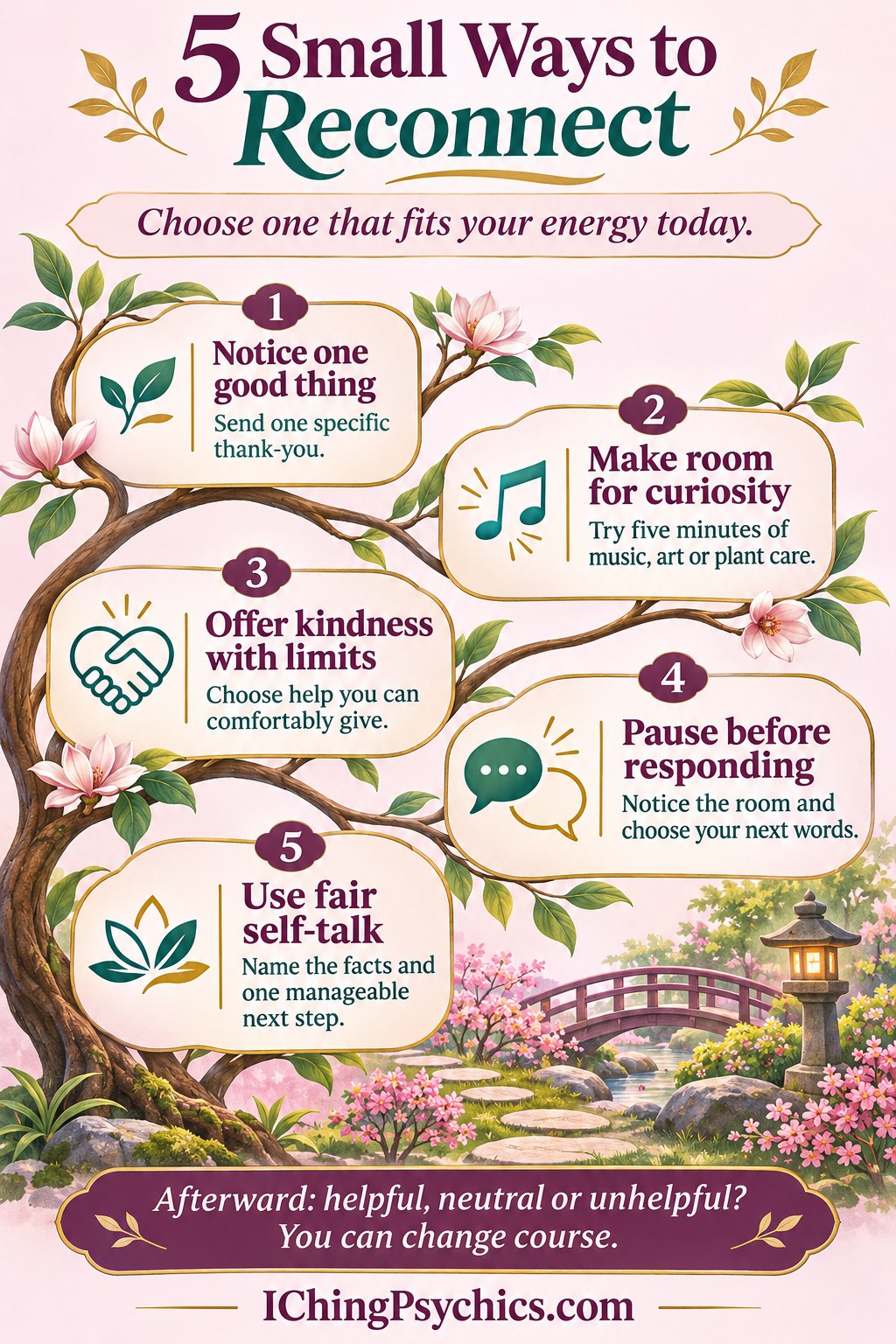
1. Make appreciation specific
Choose one thing you actually noticed: a friend who listened, a meal you enjoyed or a few quiet minutes by a window. Specific appreciation leaves room for the rest of the day to have been difficult.
Try it: send a short message naming what someone did and why it mattered. You do not need to call a painful experience a blessing or forgive someone before you are ready.

2. Follow a small moment of curiosity
Let a pleasant activity be worthwhile without turning it into a task you must master. Listen closely to a piece of music, tend a plant, try a few colors in a drawing or explore a different route on a familiar walk if it is accessible and safe.
Try it: give an activity five unhurried minutes without judging the result. If you have limited energy, looking at the sky or choosing a favorite song can be enough. Curiosity does not require an ambitious outing or a purchase.
3. Offer kindness within your limits
Choose a considerate act you can freely give: answering a friend’s message, sharing useful information or making space for someone to speak. Keep it separate from trying to earn affection or guarantee that kindness comes back in a particular form.
Try it: ask, “Would this be helpful?” before offering advice. You can care and still decline a request that exceeds your time, money or capacity. Respecting a limit can be part of the generous act.
4. Pause before your next response
Bring attention to something present: the chair supporting you, a sound nearby or the feeling of your feet on the floor. Then identify the choice in front of you. You might ask a question, take a break or wait before replying to a tense message.
Try it: say, “I am upset, and I can choose my next step.” Presence allows an emotion to be acknowledged without requiring an immediate reaction. Our decision guide for uncertain times offers a structure when a choice needs more information.
5. Make self-talk fair and useful
Listen for sweeping judgments such as “I ruin everything.” Replace them with a more accurate description and a next step: “That conversation went badly. I can consider what I want to repair and what boundary I need.” You are looking for honesty with compassion, not a cheerful slogan.
The NHS guide to reframing unhelpful thoughts recommends stepping back, examining evidence and considering another view. It also explains that a thought does not always need to be changed immediately.
Try it: ask what you would say to a friend facing the same situation. Avoid changing “I need rest” into “I have unlimited energy” when rest is what you need.
Free daily energy-and-action check-in
Copy these prompts into a private phone note. Here, energy means your own sense of capacity; you do not need a spiritual score.
- Notice: what am I feeling, and what does my body need?
- Choose: appreciation, curiosity, kindness, presence or fairer self-talk?
- Act: what is one step that fits today’s capacity?
- Review: did it feel useful, neutral or unhelpful? What would I adjust?
Example: “I feel worn out after work. I will choose kindness toward myself, decline an extra task and spend a few quiet minutes with music. Tomorrow I will check whether I need more support.”
Make room for your spiritual practice
You might pair one action with a prayer, a personal intention or a moment of reflection. If you use the I Ching, ask a question about your response rather than demanding a promise of happiness. “How can I meet this situation with care?” leaves room for choice.
Our guide to clear I Ching questions explains how to shape that inquiry. Keep practical evidence and other people’s consent part of any decision that follows.
Frequently asked questions
1. What does raising your vibration mean here?
It means using a spiritual phrase for reconnecting with care, awareness and meaningful action. This guide does not measure a physical frequency.
2. Which practice should I choose first?
Choose the smallest action that fits your current capacity. You do not need to complete all five practices in one day.
3. Must I feel positive all the time?
No. Sadness, anger and worry are part of life. A practice can make room for an emotion while helping you choose a next step.
4. Did a low vibration cause a bad event?
A hard event is not evidence that your thoughts or spiritual state attracted it. Avoid blaming yourself or another person this way.
5. Can appreciation coexist with grief?
Yes. You can appreciate one act of care while still grieving or acknowledging that something hurts.
6. What if I do not feel grateful today?
Do not force it. Try another practice or simply name what you need, such as rest, company or practical support.
7. Do I need to forgive someone to feel better?
No. Forgiveness, trust, contact and safety are separate choices. You can keep boundaries while exploring your feelings.
8. Does kindness mean saying yes?
No. Kindness can include an honest limit. Give only what you can freely offer without pressure or an expectation of a reward.
9. What if I have little time or energy?
Choose a short, accessible activity such as one song, a moment by a window or a brief supportive message.
10. Should self-talk always be cheerful?
Aim for language that is accurate and compassionate. A realistic statement about a need can be more useful than forced reassurance.
11. Can I use prayer with these practices?
Yes, if it fits your beliefs. You can pair an intention or prayer with a specific everyday action.
12. How can the I Ching fit?
Ask about your own response and choices. Avoid treating an interpretation as a guarantee of happiness or a reason to ignore evidence.
13. Do I need special products?
No. These practices do not require crystals, paid cleansing, subscriptions or a course.
14. What should I record in the check-in?
Note how you feel, the action you chose and whether it was useful, neutral or unhelpful. The aim is learning, not a perfect score.
15. When should I look for more support?
Seek suitable support when distress, fatigue or other symptoms persist or disrupt daily life. You do not need to solve a spiritual explanation first.