
Home Blog Page 9

The Methods of the I Ching

images (7)

There are two commonly known ways of communicating with the I Ching. These are the Coin Toss Method and the Yarrow Stalk Method.  Both of these are verifiable ways to  create the hexagrams vital to the consultation that will lend insight into the questions of human life.

Yarrow sticks are not easily handled, particularly since it uses forty-nine sticks in random piles.  This is why the most used method of consultation is tossing coins.  This is much easier because it uses only three coins, simply tossed six times to create the lines of the hexagram.

The yarrow stalk way is complicated as it requires the selection of fifty sticks. Out of these only forty-nine are used.  They are divided into piles. Then a stalk is selected from the pile to the right of the reader. This stalk is drawn between two fingers of the left hand.  The left pile is sorted by fours so that the remaining can be held with between the ring and middle finger.   This is then repeated with the other pile to create one change.  The two piles are then combined so that this process can be done another two times, except both of these times only four-eight stalks are selected. This may seem to get complicated as the changes must then be added to the factors of nine, which makes a yang, also knowns as firm moving line.

0

The reason behind this particular ritual is divined from the nature of the world and the New I Ching Matrix System.  If you use fifty stalks, it represents this diagram. If you take out one that one represents Oneness and Wholeness. The forty-nine stalks divided by two stand for Heaven and Earth.   The single stalks taken from the pile stand for Heaven, the Earth and the Human.  The pile counted by four stands for the separate seasons of the year.  The others stand for the remaining months. The repetitions form the hexagram.  Using the Yarrow Stalks is the best way to put to use the I Ching Book of Changes

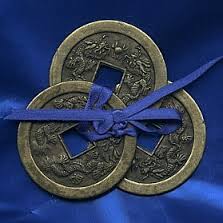
The popular use of the tossing of coins  is due to the complicated nature of the stalks.  The three coins stand for The Heavens, The Earth and the Humans. The three coins are tossed six times. This forms six lines of the hexagram. Since the seasons are not used in this method, the Chinese animals and the accompanying six stars of animals are used along with the five elements associated with the month and year with the lunar calendar.

I Ching and the 3 coins

images (3)I Ching is an ancient Chinese divination method. They use a series of coin tosses using 3 identical coins with identifiable heads and tails to determine an I Ching hexagram. I Ching book contains about 64 hexagrams, each is identified by a number and name. A hexagram is a figure composed of six horizontal lines, each line is either Yang (an unbroken line), or Yin (broken line with a gap in the center). The hexagram lines are counted from the bottom up, so the lowest line is line one while the top line is line six.

Ask open-ended questions:

The process simply is to ask open-ended question in your mind because it doesn’t return yes or no answers, then toss the three coins 6 times, assign the value, and record it to create a hexagram.

  1. Ask your open-ended question, For example, “Will I become rich?” or “What will my finances look like this year?”

istock-000013299586xsmall

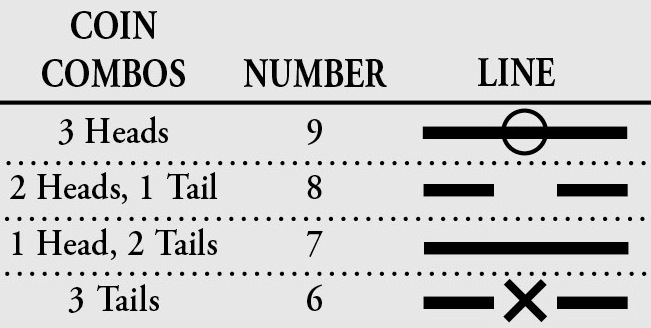
2. Hold the coins loosely ( any three coins of the same denomination, with heads and tails, will do fine), shake the coins briefly and toss them. Add up the values of the three coins, the total should be 6,7,8 or 9. Each head is 3 and each tail is 2, so if you get 2 tails and one head, then the total would be 2+2+3=7. Write down the result. This is the line 1 (the bottom line) of the hexagram.

3. Collect the coins and toss them another 5 times. And each time, write down the result above the previous result, from bottom up. After you finish tossing, you should have a column of 6 digits ranging from 6-9

4. Now, translate each number into a hexagram line, for example:

a) Number 6 is a moving Yang line, translated into unbroken line with an X in the middle.

b) Number 7 is a stationary Yang line, translated into a unbroken line.

c) Number 9 is a moving Yin line, translated into a broken line with a little circle in the middle.

d) Number 8 is a stationary Yin line, translated into a broken line.

5. Now, you have 6 vertical lines, which represent your primary hexagram.

6. To obtain your secondary hexagram, convert every moving Yang line (unbroken line with an X in the middle) to a stationary Yang line (unbroken line), and every moving Yin line (a broken line with a little circle in the middle) to a stationary Yin line (a broken line). Refer to the Hexagram Finder below to find the corresponding hexagram number and descriptions.

The Primary hexagram represents the current situation and the secondary hexagram represents the ending situation.
i-Ching-table1

You can also refer to I Ching book, to understand the meaning of your hexagram, or you can go online and find a list of hexagram interpretations. Some websites allow you to enter the results of each of your tosses by selecting the line that showed up. Once you enter all six lines, it will locate your proper hexagram and receive the meaning.

Know The 6 Benefits of I Ching

images (21)

The oracle I-Ching has helped guide people through dilemmas and problems for centuries.   The I-Ching or, as it’s also known, the Book of Changes, offers guidance over the immediate as well as changes that happen over time.

The  I-Ching was first written about in 1000 BC. Confucius expanded on the interpretations four centuries later.  Over history, the I-Ching has been used by leaders and wise men all over China.  It has been used not only as a guide but also as an assistant to political and military leaders.

Rather than the human oracle we may be thinking of, like the prophets and the Oracle at Delphi,  The I Ching is a guide that you can learn how to use without involving a third party or person to help guide you.   The I Ching can help you encourage your own intuition.

 The benefits of I Ching

article-1361787-01E5C57E00000578-692_468x373

The one constant in life is change. Change will happen whether you like it or not.  Nowadays we are told to manage change.  The I Ching is a change management tool that has a centuries old plan.

Using the I Ching can help sharpen your decision making skills and improve our time management skills.

Better decisions.  

Our level of success and happiness is reliant on good decision making.  As we face challenges, sometimes several at once, we tend to respond emotionally. This can leave us feeling inadequate  and will definitely leave us feeling flustered and unsure. The I Ching can give immediate access to the kind of principles that can calm us down and help reassure us.

Mental clarity.  When you consult the I  Ching, you should have a designated space to put yourself in the right mindset. This process alone can help you calm down and focus on the problem or question at hand.

download (18)

Focused relaxation.  If you calm yourself down you automatically become in the perfect frame of mind for creativity.  The I Ching will let you focus on your problems in a less stressful frame of mind by lining up the subconscious and unconscious parts of your mind. When these two parts of your mind connect you are prime from wisdom and effectiveness.

Non-attachment and greater objectivity Consulting the I Ching functions between the logical mind of your problem and the questioning nature of your inquiry. The casting part of your I Ching ritual will help you detach yourself from your problem.  When you separate yourself from the problem, the less emotionally you will be, making the dilemma easier to handle, regardless of what you see in your reading.

download (17)

Answers that ring true.

To truly benefit from the I Ching, you should be receptive to any ideas that may spring to mind.  Remember that it is your reading and your interpretation.  It will bring you your own insight. It will be a reading that is tailor made for you.

Clear intuition.  Consulting the I Ching helps harness  your intuitive nature because it gives your subconscious the chance to create a pattern. The interpretation of the pattern stretches your intuition. You don’t take it literally . It guides you. It doesn’t dictate.

i-Ching Psychic Readings